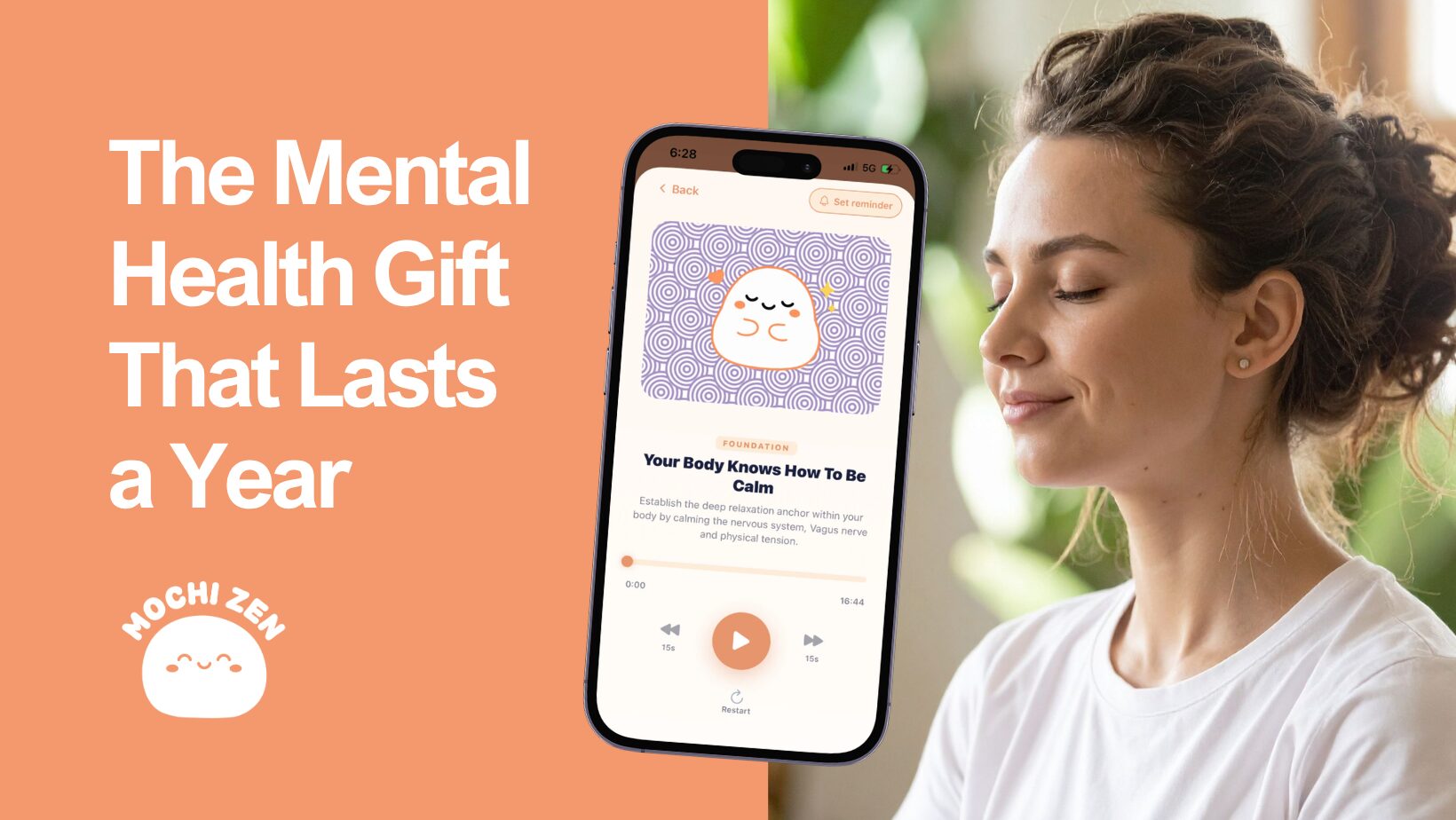
The best mental health gift is one that keeps working long after the wrapping is in the recycling, and as of today you can give exactly that: a full year of Mochi Zen, daily RTT-based hypnotherapy for anxiety, sleep and food noise. No credit card is needed to redeem it, it never expires on the person you give it to, and they choose privately which program to work on.
Think of the person you love who never stops running. The friend whose brain switches on at 3am. Your sister, who has been on and off diets since high school and is exhausted by thinking about food all day. The partner who carries stress in their shoulders and calls it "fine." You have probably already given them the candle. The journal. The spa day that was lovely for exactly one afternoon.
I'm Paola Mendez, certified RTT (Rapid Transformational Therapy) hypnotherapist, trained under the method developed by Marisa Peer, and the founder of Mochi Zen. Gifting has been the single most requested feature since we launched, because the people who feel the shift almost immediately want to hand it to someone they love. Now they can.
Give someone the quiet they have been asking for: a full year of RTT-based hypnotherapy for anxiety, sleep and food noise, $120, delivered on the date you choose.
Give a Year of Calm →What's in this article
What Makes a Good Mental Health Gift in 2026
Most wellness gifts fail for the same reason most wellness apps do: they treat a symptom for an afternoon. A weighted blanket is lovely. A meditation subscription is thoughtful. Neither of them touches the reason the person's mind won't stand down at midnight.
A mental health gift is worth giving when it meets three tests. It has to keep working past the first week, which rules out anything consumable. It has to require nothing of the recipient beyond pressing play, because someone who is already depleted will not take on a new project. And it has to work on the cause rather than the symptom, or you have simply bought them a better coping tool for the same problem.
A year of RTT-based hypnotherapy clears all three. It is daily, it asks for twenty minutes of lying down, and it works at the level where the pattern actually lives.
What a Year of Mochi Zen Actually Does for Someone
The features are not the point. Here is what this gift has looked like for real members.
Andi had been an insomniac her whole life. Within five minutes of her first 20-minute sleep session she was asleep, something she says had never happened to her before. She now describes the insomnia program as life-changing. If the person on your mind is the one who lies awake asking why they can't sleep, that is the shape the change tends to take.
Sharonda spent decades losing and regaining the same weight, more than 200 pounds across a lifetime of diets. Three weeks of daily listening quieted a mental food fight she had carried since childhood. One week she opened her journal and realised she had nothing to write under "hardest food moment." You can read her full story about quieting food noise here.
Other members describe the same quiet arriving in different rooms of their lives: the anxiety spiral that loses its grip, the 3am wake-ups that stop being a nightly appointment, the pantry that stops calling at 9pm. Individual results vary, but the pattern is consistent. Daily repetition, gentle shifts, and then one day they notice the noise simply isn't there.
"I opened my journal and realised I had nothing to write under 'hardest food moment.' There hadn't been one."
Sharonda, Mochi Zen member. Individual results vary.
Who This Gift Is For
You already know them. The friend who says "I'm exhausted but I can't sleep." The mom who has done every diet and blames herself every time. The high achiever whose mind never gives them a day off. The person who keeps saying they should "look into meditation or something" and never does, because coping tools feel like one more chore, and what they actually want is for the noise to stop.
That distinction is what a recipient feels. Mochi Zen is not asking them to manage their anxiety, count calories or white-knuckle their way to better sleep. RTT-based hypnotherapy works on the subconscious patterns generating the anxiety, the food noise or the sleeplessness in the first place, and a gifted year covers every program, so they choose what to work on, in private, at their own pace.
Stop guessing what they need. Give them access to all of it (anxiety, sleep, weight loss and emotional eating) and let them choose privately.
Give Someone Their Quiet Back →Why a Year, and Not Another 30-Day Fix
The patterns your person is carrying took decades of repetition to build. Undoing them works the same way, in reverse. A new message, heard daily in the relaxed, focused state hypnotherapy creates, gradually becomes the mind's default. That is why every Mochi Zen session is designed for daily listening rather than a one-time experience.
It helps to be honest about the timeline here, because the wellness industry rarely is. The "21 days to build a habit" line comes from a 1960 plastic surgery memoir, not from neuroscience. When researchers actually measured it (Lally and colleagues, in the European Journal of Social Psychology), the median was 66 days, with a range from 18 to 254. Reassuringly, missing a single day did not break the curve.
A month is a taste. A year is enough time for someone to change the pattern, live from the new one long enough to trust it, and stop bracing for it to come back. That is why the gift is twelve months rather than a sampler.
Does the Science Support It?
Hypnotherapy has a research base that surprises most sceptics. A meta-reanalysis in the Journal of Consulting and Clinical Psychology (Kirsch, 1996) found that people who added hypnosis to cognitive-behavioural weight loss treatment lost 14.88 pounds versus 6.03 pounds without it at the final assessment, and the advantage grew larger over time rather than fading.
For sleep, a controlled study in Sleep (Cordi, Schlarb & Rasch, 2014) found that hypnotic suggestion increased slow-wave sleep (the deep, restorative kind) by 81% in highly suggestible participants, with no adverse side effects. And the Mayo Clinic describes clinical hypnosis as a legitimate therapeutic tool: focused attention, not lost control.
App-delivered hypnotherapy has evidence of its own now, too. In 2025, Stanford researchers published an analysis of 84,395 users in a Nature journal. We broke it down in our write-up of the Stanford hypnotherapy app study. Or, for the fuller picture across all three areas, see the science behind hypnotherapy for weight loss, anxiety and insomnia.
How Gifting Works
We designed this to feel like a gift rather than a transaction, for both of you.
You choose how it arrives
Email it straight to them today, or schedule it for the morning of their birthday, Christmas, Mother's Day, whenever the moment is. Or have the gift sent to you instead, with a designed printable certificate to tuck into a card and hand over in person.
You write the message
Every gift carries a personal note from you. When they open it, they see your name and your words first, because "I see how hard you've been fighting, and you deserve ease" is the real gift. The app is only how it gets delivered.
It is effortless on their end
No credit card is needed to redeem, ever. The gift never expires on them, their twelve months start only when they are ready to begin, and nothing renews automatically at the end. They tap the link, and full access begins: every RTT-based hypnotherapy program, an AI photo meal scanner, typed-sentence logging, a USDA food search, exercise and water tracking, a macros calculator, a weight tracker and a guided journal.
One year is $120, the same price members pay. A gift should not carry a thoughtfulness surcharge.
Is a Mental Health Gift a Strange Thing to Give?
It is a fair worry: does giving someone a hypnotherapy app imply you think something is wrong with them? In my experience (as the hypnotherapist, and as someone who has received exactly this kind of gift), it lands as the opposite. The candle says "I had to get you something." This says "I actually listen when you talk." You are not diagnosing them. You are responding to what they have already told you: that they're tired, that their mind won't quiet, that they wish it were easier.
And because the gift covers every program, you are not prescribing anything either. They open a door; what is behind it is entirely theirs. If the person on your mind would benefit from deeper one-on-one work, gift certificates for private RTT sessions are also available through my practice, Pao Hypnosis.
A candle burns down in a weekend. Give them twelve months of quiet instead, scheduled for the date you choose, with your message on it.
Make Someone's Whole Year →Frequently Asked Questions
What is a good mental health gift?
A good mental health gift keeps working after the wrapping is gone. Candles, journals and spa days soothe for an afternoon. A year of daily RTT-based hypnotherapy works on the subconscious patterns generating the anxiety, the sleeplessness or the food noise, so the relief compounds instead of fading.
Is giving someone a mental health app insulting?
In practice it reads as attentive rather than critical. You're responding to something they told you themselves, such as "I can't sleep" or "I'm so stressed." Because the gift includes every program, the recipient privately chooses what to work on. You open a door; they decide what's behind it.
Does the Mochi Zen gift expire?
No. The gift code never expires on the recipient, and the twelve months only start counting the day they redeem it. If they set it aside for a few months because life is loud right now, they lose nothing at all. There is no deadline attached to the gift.
Does the recipient need a credit card to redeem a gift?
No. Redeeming takes one tap from the gift email or the printable certificate. No credit card, no payment details and no trial sign-up are required at any point. Nothing renews automatically when the gifted year ends, so they will never receive a surprise charge.
Can I schedule a gift subscription for a specific date?
Yes. You can have the gift emailed on any date up to a year out, timed for a birthday morning or a holiday. You can also send it to yourself instead and print a designed certificate to tuck inside a card and hand over in person.
What happens if they already use Mochi Zen?
The gift banks rather than overlapping. Someone on a free trial converts immediately at no charge. A paying member keeps their current period, and the twelve gifted months begin the day that period ends. Nobody is ever double-charged for the same stretch of time.
What is included in a gifted year of Mochi Zen?
Everything the app offers for twelve months from redemption: all RTT-based hypnotherapy programs covering weight loss, emotional eating, anxiety and sleep, plus an AI photo meal scanner, typed-sentence logging, a USDA food search, exercise and water tracking, a macros calculator, a weight tracker and a guided journal. There is no separate tier to upgrade to later.
Does hypnotherapy actually work, or is a hypnosis gift a gimmick?
There is peer-reviewed evidence behind it. A 1996 meta-reanalysis in the Journal of Consulting and Clinical Psychology found 14.88 pounds lost with hypnosis versus 6.03 without at the final assessment, and a 2014 study in Sleep found hypnotic suggestion increased deep slow-wave sleep. Individual results vary.
Disclaimer: This post is for informational purposes only and is not a substitute for professional medical or mental health care. Individual results vary. If you or someone you love is in crisis or experiencing severe symptoms, please consult a qualified healthcare provider.