The best gifts for someone with anxiety fall into two groups: things that calm the body for an evening — a weighted blanket, a tea ritual, a massage — and things that work on the anxious pattern itself, like therapy or daily hypnotherapy. Both are worth giving. It just helps enormously to know which one you are choosing, because only the second kind is still working in March.
When someone you love has anxiety, gift-giving gets strangely high-stakes. You want to say "I see how hard your mind works" without saying "I think you're broken." And most guides for this moment are written by shopping editors ranking products by price.
I'm Paola Mendez — certified RTT (Rapid Transformational Therapy) hypnotherapist, trained under the method developed by Marisa Peer, and founder of Mochi Zen. Anxious minds are my daily work, both with private clients at Pao Hypnosis and inside the app I built. So I've ranked these twelve by how long the relief tends to last — and yes, number one is mine, disclosed in full where it appears.
Skip the guesswork and give the one that keeps working: a year of RTT-based hypnotherapy for anxiety, sleep and food noise, $120, delivered on the date you choose.
Give a Year of Calm →What's in this article
What Makes Good Gifts for Someone With Anxiety in 2026
A gift for an anxious person has to pass a test most wellness gifts fail: it must not become one more thing to manage. Anxiety is, at its core, a nervous system convinced there is something it still has to handle. Hand that person a gadget with a setup process or a streak counter, and you have technically given them homework.
So, three questions before buying anything: Does it work without effort on their part? Does it give control back rather than take it? And does it touch the cause, or only the sensation? Comfort gifts answer the first two beautifully and the third not at all — which is fine, as long as you know that's the trade you're making.
Gifts That Soothe for an Evening
12. A candle or aromatherapy set
The classic. Lavender and chamomile have mild, real calming associations, and there's nothing wrong with a beautiful candle — as long as you know it's a mood rather than a method. Give it as the wrapping around a deeper gift, not as the gift itself.
11. A calming tea sampler
A ritual more than a remedy. The best part of a tea gift isn't the chamomile — it's that it hands your person a built-in excuse to sit down for ten minutes. Rituals matter to anxious minds: they create small islands of predictability in a day that otherwise feels reactive.
10. A spa or massage gift certificate
Wonderful, generous, and genuinely regulating for the nervous system — for about a day. If your budget allows one big gesture, this is a lovely one. Just notice that the anxious brain tends to reboot its worries somewhere around the drive home, because nothing about the underlying pattern was touched.
9. A beautiful journal
Journaling genuinely helps anxiety — putting a spiralling thought into words interrupts the spiral, which is the same principle behind the grounding technique in how to stop an anxiety spiral. The catch: a blank journal asks an already-overwhelmed person to invent their own practice. If you give one, pair it with structure — printed prompts, or an app that guides the reflection for them.
8. A weighted blanket
The most-gifted anxiety item of the decade, and it has earned the reputation — deep-pressure stimulation is calming for a lot of restless bodies. It's also the cleanest example of a comfort gift on this list: it quiets the body for the night without changing what the mind does tomorrow morning. Excellent gift. Pair it with something that works while they sleep under it.
Gifts That Help for Weeks
7. Noise-cancelling headphones
Underrated for anxious people: the ability to turn the world's volume down on demand, in an open-plan office or a loud train carriage. They're also the ideal companion to any audio-based practice — hypnotherapy sessions, sleep audio, calming music — which is why they pair so well with number one on this list.
6. A yoga class pack
Movement plus breath is real medicine for an anxious nervous system, and a class pack adds the two things anxious people are worst at giving themselves: scheduled time, and permission to take it. Yoga is personal for me — it's what led me to hypnotherapy in the first place.
5. A book that explains their brain to them
For the anxious person who needs to understand a thing before they'll try it, a good book on how anxiety works can be the door-opener no product is. Choose explanation over willpower-based advice — anxious brains have heard "just breathe" enough for one lifetime.
4. A meditation app subscription
Honest take, competitors included: Calm and Headspace are polished, pleasant and genuinely helpful, and daily meditation does build a calmer baseline over time. The limitation is the one I wrote about in why most anxiety apps help you cope instead of changing the cycle — coping tools manage the anxiety that keeps arriving. They don't ask why it keeps arriving. If they've already tried one and drifted off it, the honest comparison of Calm alternatives covers what else is out there.
Give them relief that's still working in March — every program included, so they choose privately what to work on.
Give Someone Their Quiet Back →Gifts That Work on the Source
3. A therapy session (or a few)
If your person has been saying "I should really talk to someone," helping fund that is one of the most loving gifts there is. One etiquette note from experience: offer it privately, frame it as "I want to remove the obstacle," and let them choose the provider themselves. Control is the whole currency here.
2. A private RTT hypnotherapy session
For one big, deep gesture: a single 90-minute RTT session goes after the specific subconscious root of a person's anxiety — the original pattern their mind keeps replaying, usually formed long before they had words for it. I offer gift certificates through my practice, Pao Hypnosis, in Miami or remotely, and hypnotherapists in your own city very likely do the same.
1. A year of daily hypnotherapy — the Mochi Zen gift
Full disclosure: I built this one, and it's precisely because of everything above that I did. Comfort gifts fade and single sessions end. What actually changes an anxious pattern is repetition — a new message delivered daily, in the relaxed and focused state hypnotherapy creates, until it becomes the mind's default rather than the exception.
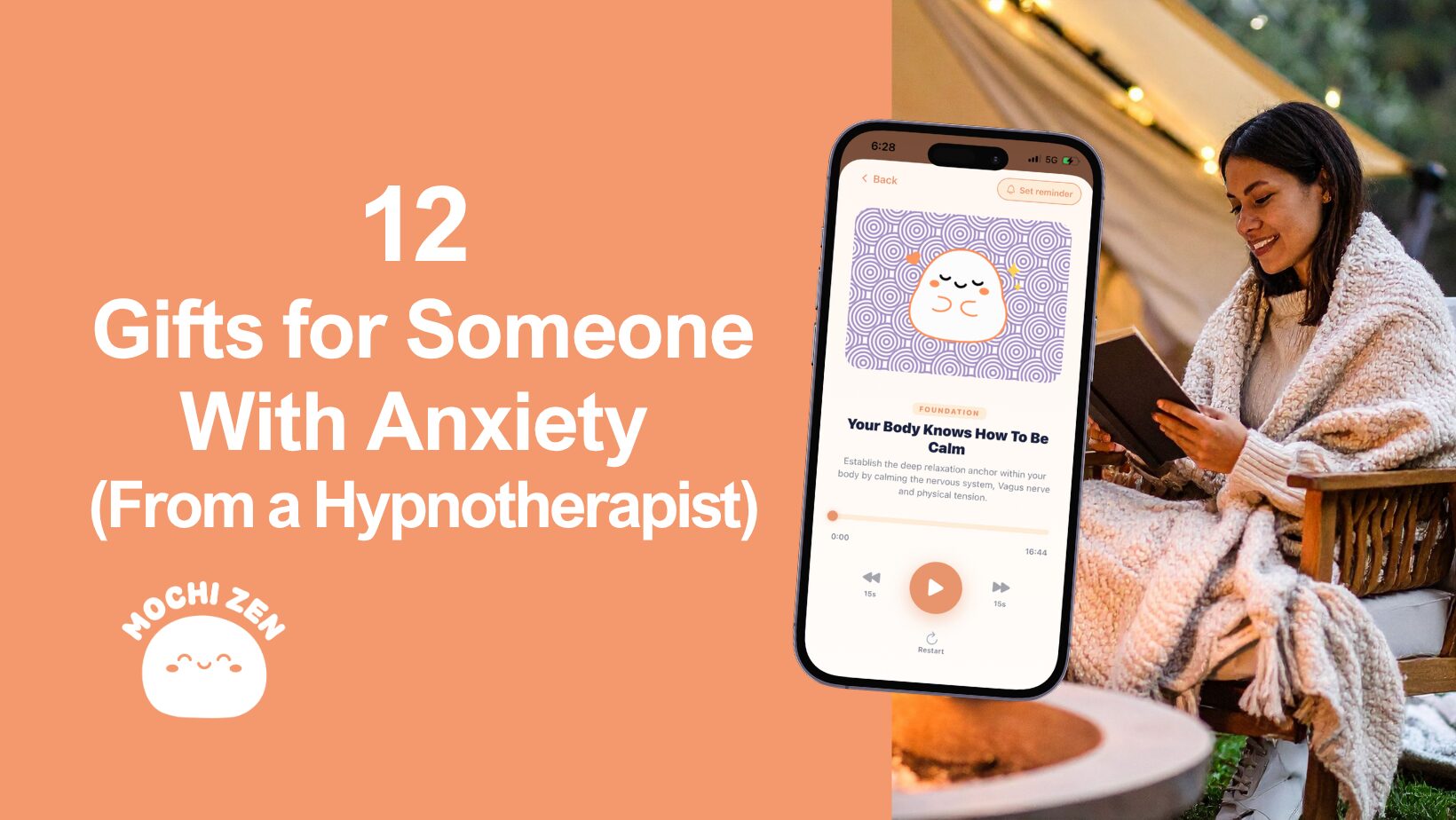
A Mochi Zen gift year gives your person daily RTT-based hypnotherapy for anxiety, plus the sleep and food-noise programs — they choose which, privately, and you never have to guess. The evidence base is real without being oversold: a randomized controlled trial published in the Journal of Clinical Psychology in Medical Settings (Roberts et al., 2021) found hypnosis significantly reduced anxiety from baseline and was superior to the control condition, with benefits holding regardless of how hypnotizable participants were. The Mayo Clinic describes clinical hypnosis the same way I do to nervous clients: focused attention, not lost control. Individual results vary.
It's $120 for the year, it arrives with your personal message on the date you pick — or as a printable certificate to hand over in person — it never expires on them, nothing auto-renews, and no credit card is needed to redeem it. It is the difference between giving someone a quiet evening and giving them a quieter mind.
How Do You Choose Between Them?
Match the gift to what they've told you. If they describe a body that won't settle — jaw, shoulders, restless legs at bedtime — comfort gifts land beautifully. If they describe a mind that won't stop — replaying conversations, rehearsing disasters, waking at 3am to worry — comfort will feel nice and change nothing, and something at the top of this list will serve them far better.
Not sure? Combine. The best version of this gift I've seen is a small comfort object to open in the room — the blanket, the headphones — paired with a card carrying the year of hypnotherapy. One gives them something to hold that evening; the other is still working when the season is over. If their anxiety shows up around food specifically, the anxiety-after-eating loop explains why the two so often travel together.
What Should You Not Give Someone With Anxiety?
A few well-meaning gifts reliably land wrong. Self-help books that boil down to "try harder" — anxious people already try harder than anyone you know. Anything with a streak counter, which converts a gift into an obligation by week two. Surprise experiences that remove their sense of control, the anxious brain's least favourite thing. And caffeine-adjacent treats for a nervous system already running hot.
Watch the wording as much as the gift, too. Avoid "you need this" and anything implying they're broken. Better: "you're always taking care of everyone — this one's just for you." Let the gift be about ease rather than diagnosis, and let them decide what to do with it.
When in doubt, choose the gift that gives control back rather than adding one more thing to manage. That principle holds whether you're buying Christmas gifts for someone with anxiety, a birthday present, or something for no reason at all. If you want the drug-free options ranked on their own terms, 10 natural anxiety remedies that actually work covers what's genuinely worth trying.
A candle burns down in a weekend. Give them twelve months of quiet instead — with your message on it, on the date you choose.
Make Someone's Whole Year →Frequently Asked Questions
What do you buy someone who has anxiety?
Choose a gift that either calms the body — a weighted blanket, a massage, a tea ritual — or works on the pattern itself, such as therapy or hypnotherapy. The most thoughtful anxiety gifts deliver relief without adding obligations: nothing with streaks, pressure or a learning curve.
Is it offensive to give someone a mental health gift?
Not when it responds to something they've told you themselves. If your friend has said their brain won't switch off, a calming gift says you were listening. Avoid framing it as fixing them and frame it as caring for them, and it lands as attentive rather than critical.
Do weighted blankets really help anxiety?
Many people find them genuinely calming, and deep-pressure stimulation is a well-liked comfort tool for restless bodies. Treat it as comfort rather than treatment: a weighted blanket can quiet the nervous system for the night without changing the underlying anxious pattern that returns tomorrow.
Does hypnotherapy actually help with anxiety?
There's peer-reviewed support. A randomized controlled trial in the Journal of Clinical Psychology in Medical Settings found hypnosis reduced anxiety significantly from baseline and was superior to the control condition. RTT-based hypnotherapy works on the subconscious pattern generating anxious thoughts. Individual results vary.
What is a good anxiety gift under $25?
A calming tea sampler, a guided journal or a quality candle all sit under twenty-five dollars. For a few dollars more, pair a small comfort item with a card that names what you admire about them — how much they carry, and how gracefully. The words do the heavy lifting.
What is the best gift for severe anxiety?
For severe or clinical anxiety, the most caring gifts support professional help — contributing to therapy, or something that complements care they already receive. A wellness app or hypnotherapy program supports treatment but doesn't replace it, so never position it as a substitute for a clinician.
Can you gift a hypnotherapy app subscription?
Yes. Mochi Zen offers a one-year gift for $120, delivered by email on a date you choose or as a printable certificate. The recipient redeems it with one tap, no credit card is required, nothing auto-renews, and the gift never expires on them.
What is the 3-3-3 rule for anxiety?
Name three things you can see, three sounds you can hear, and move three parts of your body. It's a grounding technique that interrupts a spiral by pulling attention out of the thought and into the room. Useful in the moment — it settles the episode without changing the pattern underneath it.
Disclaimer: This post is for informational purposes only and is not a substitute for professional medical or mental health care. Individual results vary. If anxiety is severely affecting your life, or someone you love is in crisis, please consult a qualified healthcare provider. Mochi Zen and Pao Hypnosis are the author's businesses.