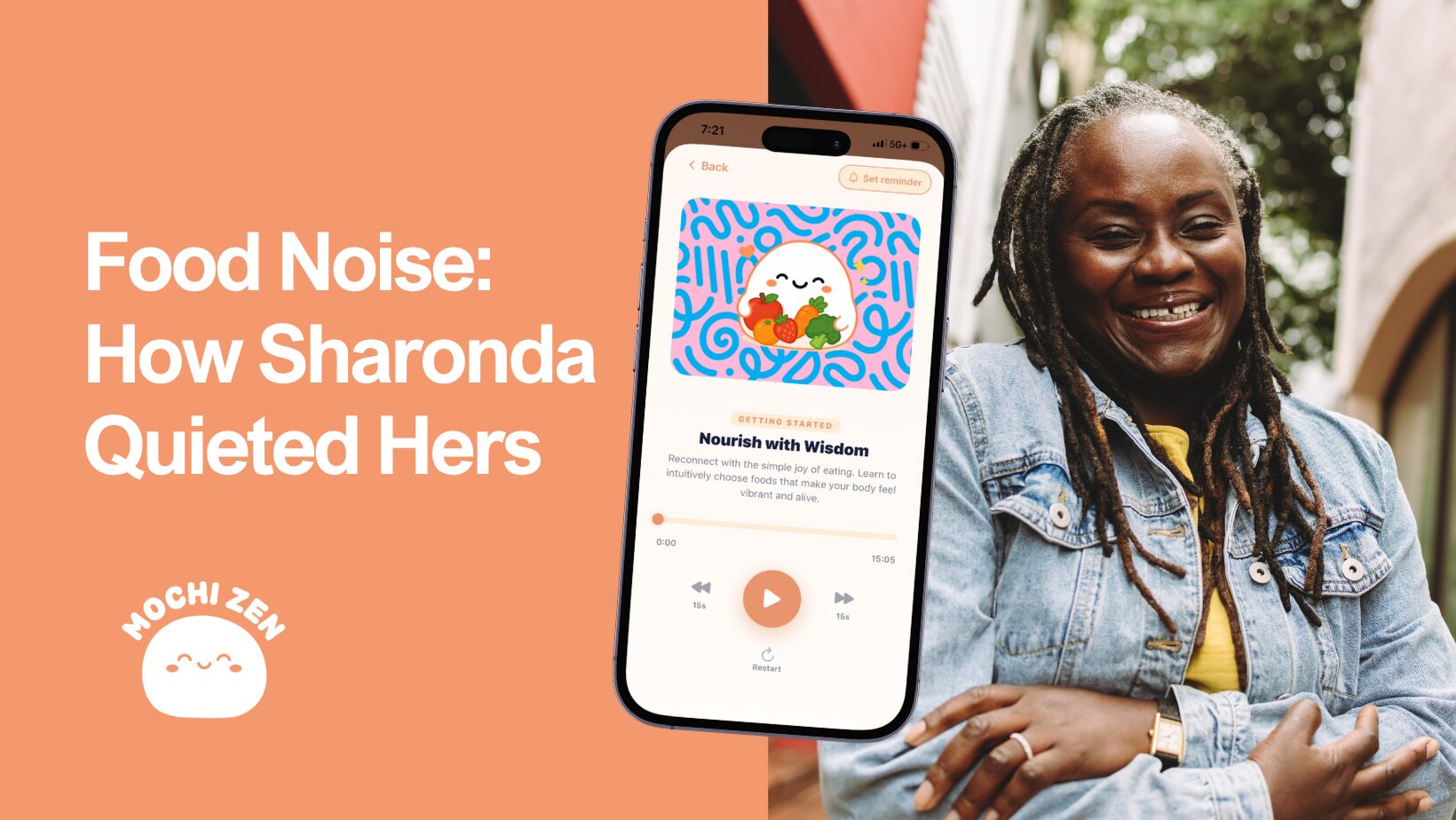
Food noise quiets when you change the subconscious pattern generating it, not when you find a stricter diet. For Sharonda, a military veteran who had lost and regained more than 200 pounds over her lifetime, that meant listening to one hypnotherapy session daily for three weeks. This is her story, and the science behind why it worked.
Sharonda knows what fit feels like. She served in the military. She was an athlete. And for most of her adult life, none of that mattered at 9pm, because the thinking about food never stopped. "By my early 50s, thinking about food and my weight had become like a second job," she told me. "Not a day went by that I didn't think about it."
I'm Paola Mendez, certified RTT (Rapid Transformational Therapy) hypnotherapist, trained under the Marisa Peer method, and the founder of Mochi Zen. I hear versions of Sharonda's sentence constantly, and that constant mental chatter has a name now: food noise. If you have it, you already know it isn't hunger. It's the running commentary of cravings, rules, guilt, and negotiations that plays in the background of your day.
Mochi Zen's RTT-based weight loss program works on the subconscious patterns behind food noise, not the food on your plate. Full access free for 7 days, no credit card required.
Quiet the Food Noise: Try Mochi Zen Free →What's in this article
What Is Food Noise? (And Why Everyone Is Talking About It in 2026)
Food noise is the near-constant stream of intrusive thoughts about eating: what you just ate, what you'll eat next, what you shouldn't eat, whether you've "ruined it" today. The term went mainstream in the conversation around GLP-1 medications like Ozempic, because many patients describe the drugs' most surprising effect as mental quiet: the chatter simply stops.
But medication isn't the only path to quiet, and it doesn't address why the noise exists. Food noise is a subconscious pattern: a set of learned associations (food as comfort, food as reward, food as the thing you must control) rehearsed over decades until they run automatically. That's why knowing better doesn't fix it. As I've written before, willpower operates at the conscious level, and the noise doesn't live there. And if you're weighing your options, I've also ranked the best apps for food noise honestly, competitors included.
Sharonda's Story: 200 Pounds, Lost and Found
Sharonda's pattern will be familiar to almost every chronic dieter: "I spent my whole life caught in the same cycle: lose the weight, get off track, gain it back. Over my lifetime, I've probably lost and gained well over 200 pounds."
She wasn't failing for lack of discipline: this is a woman who served in the military. "I was consistent with my workouts, but what I saw in the mirror didn't reflect the work I put in." And the pattern wasn't confined to food: "That same one-step-forward-two-steps-back pattern showed up in my career and my finances too."
The Realization: The Block Was Never Effort
That last observation, the same cycle appearing in areas that had nothing to do with food, is what cracked the case. "That's when it hit me: the block wasn't effort. It was mental. I didn't want another diet. I wanted ease and flow. I wanted to be pulled by the vision instead of pushed by the pain."
This is the insight that separates people who break the cycle from people who buy another meal plan. When the same self-sabotage pattern follows you across food, money, and career, the common denominator isn't the food; it's the subconscious programming underneath all three.
What She Actually Did, Day by Day
"When I learned that repetition is what makes hypnotherapy work, I decided to really show up for myself." Sharonda's practice had three parts, none of them complicated:
She listened every single day. Not when she felt like it: daily, the way you'd train at a gym.
She stayed with one session. "The session that clicked for me was Nourish with Wisdom. Getting nutrition right, but making it easy, was what I needed most, so I stayed with it for three full weeks before moving on to the others." Repeating one session until it settles beats sampling everything once.
She tracked the inner change, not just the scale. She used the guided journal to watch her thinking shift, and logged her weight as it started to drop.
If that sounds doable, that's the point. Begin with the same 5-minute intro session Sharonda did and let the practice build from there.
Stop Fighting Cravings: Start Your Free Week →Why Repetition Is the Whole Method
Think of how you got the food noise in the first place: thousands of small repetitions (clean your plate, food is love, you deserve a treat, you blew it again) until the pattern ran without your permission. Neuroplasticity works the same way in reverse. A new message, heard daily in the relaxed and focused state that hypnotherapy creates, gradually becomes the mind's new default. The practice compounds, the way going to the gym compounds: the more consistently you show up, the more the results build on each other.
This is the core of RTT: Rapid Transformational Therapy, the method developed by Marisa Peer, and it's why every Mochi Zen session is designed to be listened to daily rather than once.
What the Science Says
Hypnotherapy for weight loss has a research base that surprises most skeptics. In a meta-reanalysis published in the Journal of Consulting and Clinical Psychology, Kirsch (1996) found that people who added hypnosis to cognitive-behavioral weight loss treatment lost 14.88 pounds by the final assessment versus 6.03 pounds without it (an effect size of 0.98), and the advantage was larger at the final follow-up than right after treatment.
More recently, a first-of-its-kind 2025 trial at Hadassah Medical Center reported that participants lost an average of 10% of their body weight after six hypnosis sessions simulating gastric sleeve surgery: interim results the researchers described as comparable to actual bariatric surgery, with 86% of participants still losing weight three months later.
And for the "is hypnosis even real?" question: the Mayo Clinic describes hypnosis as a legitimate clinical tool: a state of focused attention and heightened suggestibility, not a loss of control. For a deeper dive into the research, see does hypnosis for weight loss actually work?
What Changed, and How Quietly It Happened
Nobody has a lightning-bolt moment in this work, and Sharonda didn't either. "The changes came quietly. First I noticed I didn't feel the same pull to the pantry. Then I was making different choices at social events without even trying. The food noise started to quiet down."
Then came the moment that tells you the pattern itself has moved: "One week I opened my journal and realized I had nothing to write under 'hardest food moment.'" The noise hadn't been managed. It had gone quiet.
She even caught the new beliefs showing up in the wild: "I caught myself talking to myself in the words from my sessions ('processed food is cardboard, it doesn't tempt me at all') and standing in the grocery store: 'I shop for the life I want to live.'"
"I'm twenty pounds down, but honestly, the number isn't what surprises me most. It's that listening to Mochi Zen became a daily practice I look forward to; it's how I start my morning off right. After a lifetime of white-knuckling it, nothing about this feels like fighting anymore."
Sharonda, Mochi Zen member
Individual results vary.
How to Start Your Own Practice
Sharonda's playbook, distilled: start with the 5-minute intro session so your mind knows what hypnotherapy actually feels like (deep relaxation; you stay aware and in control the whole time). Pick the session that names your pattern. Listen daily, and stay with the same session for at least a week; three, if it's really working on something. Journal what you notice. Let the scale be the lagging indicator, not the scoreboard.
And if your food noise is tangled up with anxiety or sleepless nights, as it is for many of us, one membership covers all three programs, because they're usually the same root system. For deeper one-on-one RTT work, I also see private clients at Pao Hypnosis in Miami and remotely worldwide.
A lifetime of food noise doesn't need a lifetime to quiet. One session, every day, and let the repetition do the work.
Make Peace With Food: Try Mochi Zen Free for 7 Days →Frequently Asked Questions
What is food noise, exactly?
Food noise is the constant, intrusive mental chatter about eating: cravings, planning, guilt, and rules that run in the background of your day even when you're not hungry. It's a learned subconscious pattern, not a character flaw, which is why it doesn't respond to willpower.
Is food noise a real medical term?
It's not a formal diagnosis, but clinicians and researchers use it widely, especially in discussions of GLP-1 medications like Ozempic, to describe persistent, preoccupying thoughts about food that continue even when the body doesn't need fuel.
How do you stop food noise without medication?
Because food noise is a learned subconscious pattern, approaches that work at the subconscious level, like hypnotherapy practiced daily, can quiet it at the source. Sharonda noticed her noise fading within weeks of listening to one RTT-based session every day.
Does hypnotherapy actually work for weight loss?
A 1996 meta-reanalysis in the Journal of Consulting and Clinical Psychology found people who added hypnosis lost 14.88 pounds versus 6.03 pounds without it at the final assessment, and a 2025 Hadassah Medical Center trial reported results comparable to gastric sleeve surgery. Individual results vary.
How long does it take to quiet food noise with hypnotherapy?
Most people need daily repetition for at least one to three weeks per session before changes settle in. The shifts tend to arrive quietly (less pull toward the pantry, easier choices at social events) rather than as one dramatic moment.
Do I have to diet while using hypnotherapy?
No. The approach works on why you eat rather than restricting what you eat. Mochi Zen pairs the hypnotherapy sessions with optional nutrition tools (photo and typed food logging, USDA search, exercise and water tracking, macros, and weight tracking) for awareness without restriction.
What if I fall asleep during a hypnotherapy session?
It still counts. Your mind continues processing the session even as you drift, and many members deliberately listen at night for exactly that reason. What matters most is showing up daily, not staying alert for every minute.
Is hypnosis safe?
For most people, yes; the Mayo Clinic describes clinical hypnosis as a safe, legitimate therapeutic tool. You remain aware and in control throughout. Mochi Zen is a wellness tool, not a substitute for professional medical care; if you have a clinical condition, follow your clinician's guidance.
Disclaimer: This post is for informational purposes only and is not a substitute for professional medical or mental health care. Individual results vary. Sharonda's story is shared with her permission. If your relationship with food is severely affecting your health or daily life, please consult a qualified healthcare provider.