She called me mid-spiral.
A client, someone I'd been working with for a few months, reached out in a panic. An automation tool critical to her work had been banned without explanation. She'd submitted an appeal and was waiting for the response. But waiting was the one thing she couldn't do.
She was listing everything at once: what would happen to her deadlines, what her clients would think, what she'd do if the ban wasn't reversed, how long it could take, whether there was a backup, how she'd explain it. Each scenario was feeding the next one. The spiral was fully underway.
I let her finish. Then I asked her one question.
"Is there anything else you can do right now to help this situation?"
She paused. "No. I submitted the appeal. I just have to wait."
"Then let's try something. In this exact moment, not five seconds ago, not five seconds from now, are you okay? Are you safe?"
Silence. A breath.
"Yes," she said. "I'm okay."
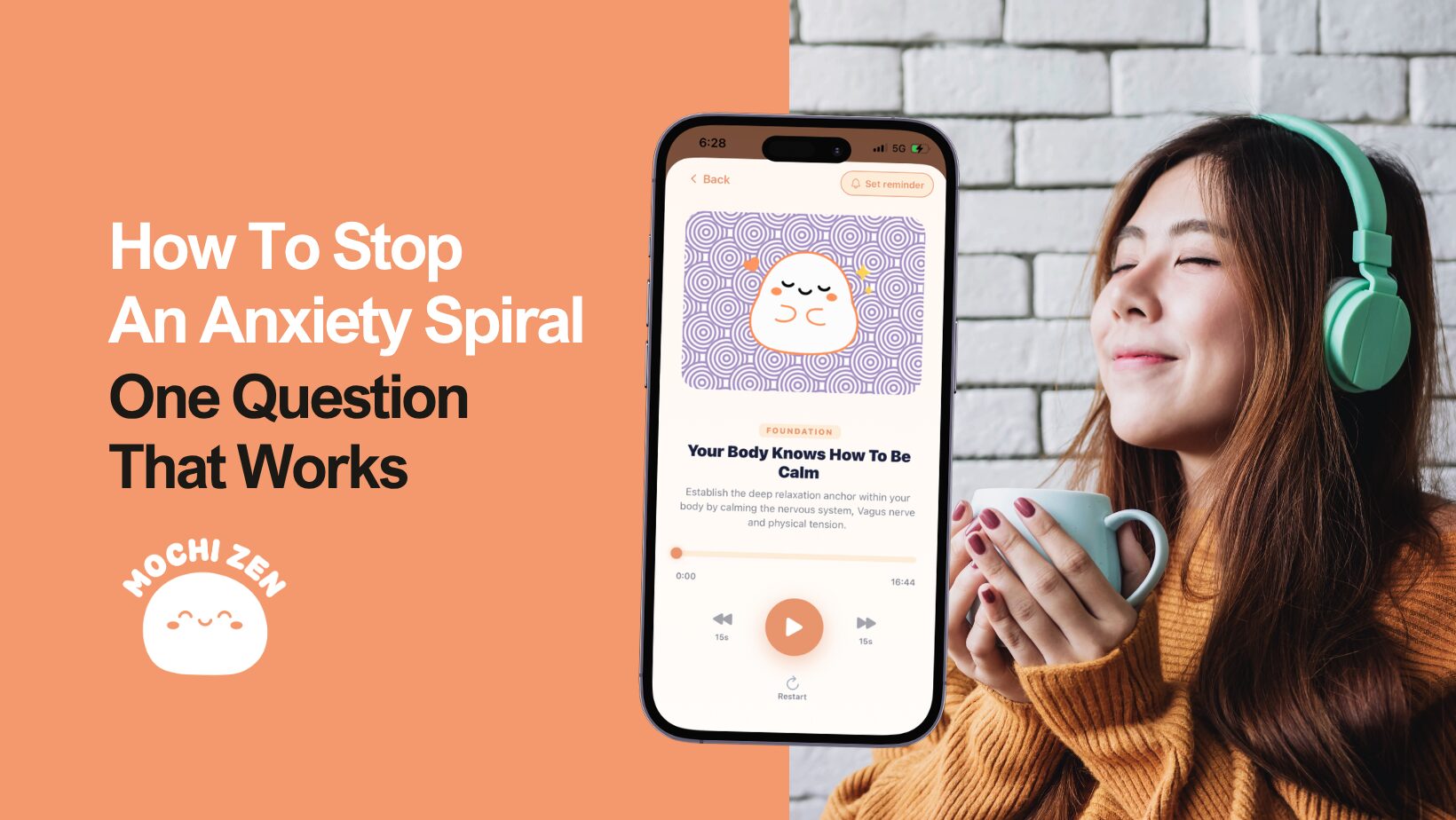
That pause was the beginning of getting her nervous system out of crisis mode. We did some grounding work together, and by the end of the call she was calm enough to get back to her day. She used the Body Knows Calm session in the Mochi Zen app to carry her through the rest of it.
The appeal was reversed. Nothing happened. But the hours between the crisis call and that resolution would have been unbearable without something to interrupt the spiral.
Here's why that question works, and how to use the full technique yourself.
The Mochi Zen Body Knows Calm session is built for exactly this moment: when the spiral has started and you need something to carry you through. Try it free for 7 days.
Stop the Spiral: Try Free →In This Article
Why Anxiety Spirals the Way It Does
An anxiety spiral isn't random. It follows a very specific pattern, and once you see it, it becomes much easier to interrupt.
Your brain has a system called the default mode network, a set of regions that activate when you're not focused on a task. Its job is to process the past and simulate the future. It's why your mind wanders to unresolved situations, replays conversations, and runs "what if" scenarios. In evolutionary terms, this was useful: anticipating threats kept you alive.
The problem is that your nervous system cannot distinguish between a thought about a threat and an actual threat. When you vividly imagine a worst-case scenario, your body responds as if it's happening: cortisol rises, heart rate increases, breathing shallows. The more detailed the scenario, the stronger the physical response. And the stronger the physical response, the more urgent the thoughts feel, which generates more scenarios, which amplifies the physical response further.
That's the spiral. Each loop makes the next one more intense, because the anxious body is now feeding anxious thoughts, which are feeding an even more anxious body.
My client wasn't responding to her actual situation: a submitted appeal, a waiting period, nothing she could do. She was responding to the story her mind was generating about every possible future outcome of that situation. The present moment was neutral. The narrative her brain was running was catastrophic.
To interrupt the spiral, you have to bring attention back to what's actually true right now.
The Question That Interrupts It
The question I asked her is deceptively simple:
"In this exact moment, not five seconds ago, not five seconds from now, are you okay? Are you safe?"
What makes it work is the specificity of the time frame. Not "are things going to be okay?" (which opens the door to more future projection). Not "is everything fine?" (which invites a list of everything that isn't). Just: right now, in this exact moment.
Most of the time, even in the middle of a genuine crisis, the honest answer to that question is yes. You are physically safe. You are breathing. The present moment itself is tolerable, often even neutral. The distress is coming from the narrative, not the now.
When my client paused and actually checked (really checked, instead of continuing the spiral), she found that she was sitting in a comfortable space, breathing fine, physically safe. The crisis was real. Her distress about it was real. But the catastrophe her mind was running hadn't happened yet and might never happen.
That pause is enough to create a gap in the spiral. And in that gap, you can begin to regulate.
The Full 3-Step Technique
How to Stop an Anxiety Spiral
- 5 things you can see: look around and name them specifically
- 4 things you can physically feel: your feet on the floor, the chair under you, the temperature of the air
- 3 things you can hear: background sounds, your own breath, anything
- 2 things you can smell, or if you can't identify any, take two slow breaths and notice how the air feels
- 1 thing you can taste
This full sequence takes two to three minutes. My client and I worked through it together on the phone. By the end, she described her thoughts as "quieter," still there, but no longer running the show.
Why This Works (The Neuroscience)
This isn't just a feel-good technique. There's solid neuroscience behind each step.
Psychologist Daniel Gilbert's research on affective forecasting adds another layer: his studies found that humans consistently and significantly overestimate how bad anticipated negative events will actually be. We predict our emotional response to future difficulties will be more intense and longer-lasting than it turns out to be. The spiral is partly fueled by a brain that genuinely believes the catastrophe ahead will be as bad as it feels right now, and Gilbert's research shows that belief is almost always wrong.
The grounding question directly challenges that projection. It doesn't deny that the future problem might be real. It simply returns attention to what's actually true in the present moment, which is almost always more manageable than the anticipated version.
What to Do After the Spiral Stops
The technique interrupts the spiral. It doesn't resolve whatever caused it.
After my client and I finished the grounding work, she still had an appeal pending and a workday to get through. The situation hadn't changed; only her nervous system had stepped back from crisis mode, which gave her the capacity to function while she waited.
For the rest of the day, she used the Body Knows Calm session in the Mochi Zen app, an RTT-based hypnotherapy audio session designed specifically to help the nervous system settle and maintain a regulated baseline when circumstances are stressful and out of your control. She told me afterward that returning to it every time she felt the spiral starting was what got her through the waiting.
That's the honest picture of what in-the-moment techniques do: they give you your capacity back. They don't change the situation. They change your ability to move through it without your nervous system making everything harder.
If anxiety spiraling is a regular pattern for you (not just a one-off crisis response but something that happens repeatedly, over multiple situations, even when the actual risk is small), that's a signal worth paying attention to. A nervous system that defaults quickly to worst-case thinking is usually running a subconscious belief about how safe (or unsafe) the world is. That belief responds very well to RTT hypnotherapy, which goes to the source rather than just managing what the source produces.
For more on the anxiety techniques that work in the moment, read: 10 Natural Remedies for Anxiety That Actually Work →
For the science behind how hypnotherapy addresses anxiety at the root: The Science Behind Hypnotherapy for Weight Loss, Anxiety & Insomnia →
The Body Knows Calm session in Mochi Zen was built for exactly the moments between crisis and resolution: when you've done everything you can and now you have to wait. RTT-based hypnotherapy, available the moment you need it.
Try Mochi Zen Free for 7 Days →Frequently Asked Questions
What is an anxiety spiral?
An anxiety spiral is a self-reinforcing loop where anxious thoughts generate physical stress responses (elevated cortisol, increased heart rate, shallow breathing), which make the thoughts feel more urgent, which generates more anxious thoughts. Each cycle amplifies the one before it. The spiral typically runs on imagined future scenarios or replayed past events rather than anything happening in the present moment, which is what makes present-moment grounding techniques so effective at interrupting it.
How do I stop an anxiety spiral quickly?
The fastest way is to redirect attention from the narrative (the story your mind is running about what might happen) to present sensory experience. The question "In this exact moment, am I okay? Am I safe?" creates the initial pause. The 5-4-3-2-1 grounding technique (naming five things you see, four you can feel, three you can hear, two you can smell, one you can taste) anchors attention in the present. Together these can interrupt a spiral in under two minutes.
What is the 5-4-3-2-1 grounding technique?
5-4-3-2-1 is a sensory grounding technique that uses present-moment awareness to interrupt anxious rumination. You name five things you can see, four things you can physically feel, three things you can hear, two things you can smell, and one thing you can taste. By directing attention to direct sensory experience, it interrupts the default mode network activity responsible for anxiety spirals and pulls the nervous system back into the present, where the threat being anticipated usually doesn't exist.
Why do anxiety spirals feel so real even when nothing is actually wrong?
Because your nervous system cannot distinguish between a vividly imagined threat and a real one. When you mentally simulate a worst-case scenario in detail, your body responds as if it's occurring: cortisol rises, heart rate increases, breathing shallows. The physical stress response then makes the thoughts feel more urgent and credible, which generates more detailed scenarios, which amplifies the response further. The spiral feels real because your body is having a real physiological experience; it's just being triggered by imagination rather than actual events.
Does deep breathing help with anxiety spirals?
Yes, specifically slow exhalation. Exhaling for longer than you inhale activates the parasympathetic nervous system (the rest-and-digest state), which directly counteracts the fight-or-flight activation driving the spiral. A simple pattern: inhale for 4 counts, exhale for 6–8 counts. Even three slow breaths with extended exhales can begin to shift your nervous system out of crisis mode. Deep breathing works best as part of a complete grounding sequence, after the grounding question and 5-4-3-2-1, rather than in isolation.
Why do I keep having anxiety spirals even when I know I'm catastrophizing?
Because knowing you're catastrophizing doesn't stop the spiral, and this frustrates many people. The spiral is driven by the subconscious nervous system, not the conscious mind. Consciously recognizing "I'm catastrophizing" doesn't override the subconscious belief that the catastrophe is real and imminent. In-the-moment techniques like grounding can interrupt the spiral. But if spiraling is a recurring pattern, the more lasting solution is to address the underlying subconscious belief driving it, which is where RTT hypnotherapy is particularly effective.
What is RTT hypnotherapy and how does it help with anxiety?
RTT (Rapid Transformational Therapy), developed by world-renowned therapist Marisa Peer, works by accessing the subconscious mind directly to identify and update the beliefs driving anxiety. Rather than managing anxiety symptoms in the moment, RTT addresses the root: the subconscious conclusion (often formed in a specific early experience) that the world is unsafe, that things will go wrong, or that you don't have the resources to cope. When that belief changes, the nervous system's default response changes with it. Many clients report a significant reduction in how quickly and intensely they spiral, not just better tools for managing the spiral once it starts.
How is Mochi Zen different from other anxiety apps?
Most anxiety apps offer meditation, breathing exercises, or mood tracking: all useful, but all operating at the surface level. Mochi Zen combines RTT-based hypnotherapy audio sessions (built on the methodology developed by Marisa Peer and created by me, Paola Mendez, certified RTT practitioner) with AI nutrition tracking and habit tools. The hypnotherapy sessions work at the subconscious level, addressing the beliefs and nervous system patterns that drive anxiety, emotional eating, and sleep problems, not just providing coping strategies for the symptoms. The Body Knows Calm session specifically is designed for moments of acute stress when your nervous system needs to settle and you need something to carry you through.
Disclaimer: This post is for informational purposes only and is not a substitute for professional medical or mental health care. If anxiety is significantly affecting your daily life, please consult a qualified healthcare provider.