Most anxiety apps help you cope better. Breathing timers. Mood logs. Guided relaxation. Those things have genuine value. But they work on the surface; they help you manage what's happening in the moment without touching why your nervous system keeps generating anxiety in the first place.
The difference between coping and changing is the difference between managing a symptom and removing its cause. And that difference comes down to one thing: whether the tool you're using can access your subconscious mind, because that's where the anxiety cycle was originally formed.
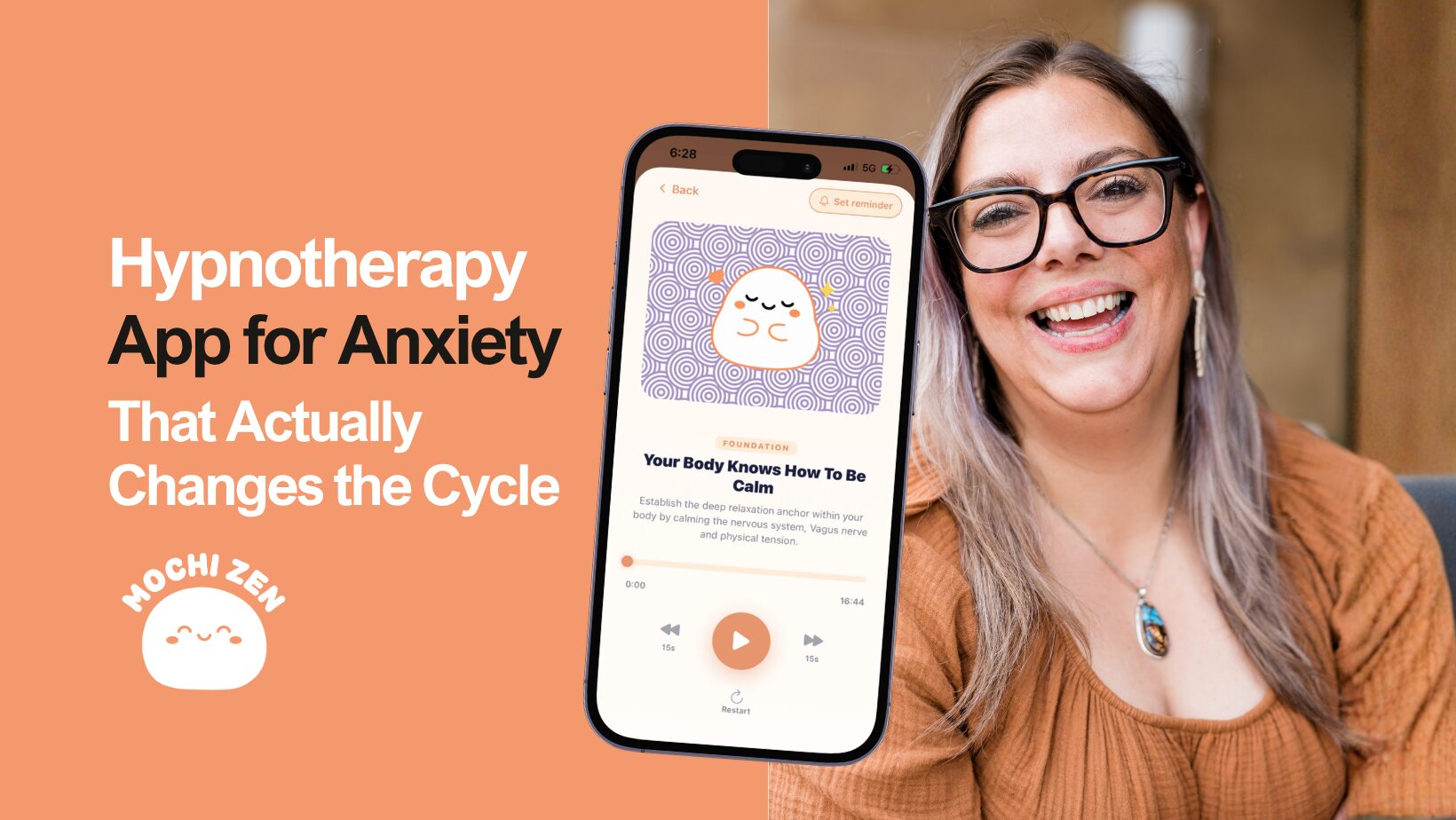
Mochi Zen was built on this premise. It combines RTT-based hypnotherapy audio, developed by Paola Mendez (Certified RTT Hypnotherapist, trained by Marisa Peer), with the consistency tools that make subconscious change last. This post shares one client's real experience, and explains why what happened to her makes complete sense from a neuroscience standpoint.
Your anxiety isn't a character flaw. It's a subconscious cycle. And cycles can be broken.
Start Your 7-Day Free Trial →In This Post
- Why Most Anxiety Solutions Work on the Wrong Layer
- What Changes When You Go Subconscious
- The 21-Day Recording: The Part That Makes It Last
- One Client's Experience
- How Mochi Zen Delivers RTT-Based Hypnotherapy for Anxiety
- Why Consistency Is the Hidden Variable in Anxiety Recovery
- Is a Hypnotherapy App Right for Your Anxiety?
- Frequently Asked Questions
Why Most Anxiety Solutions Work on the Wrong Layer
Here's something no wellness app wants to admit: most of them are built for the conscious mind. They give you things to do, breathe, notice, track. Useful things. But anxiety doesn't live in the conscious mind; it lives in the subconscious, where the nervous system runs its cycles far beneath the reach of apps that ask you to log your mood or breathe for four counts.
This isn't a criticism of those tools. Breathwork activates the parasympathetic nervous system. Mood tracking builds self-awareness. These are real mechanisms with real effects. But they're regulation tools: they help your system calm down after anxiety activates. They don't ask why anxiety keeps activating in the first place.
The answer to that question is almost always subconscious. At some point, often much earlier than you'd expect, your nervous system learned that something was threatening. It encoded a belief: that certain situations, feelings, or patterns of thought require a threat response. And it has been faithfully running that cycle ever since, regardless of whether the original threat still exists.
Until that belief is updated, the cycle keeps running. The anxiety loop keeps cycling, triggered by stress, by situations, by things that shouldn't logically cause alarm. No amount of coping will stop a cycle that's still actively running. The only thing that stops it is going in and changing it.
What Changes When You Go Subconscious
RTT (Rapid Transformational Therapy) is a methodology developed by world-renowned therapist Marisa Peer that does exactly this. It uses hypnotherapy to access the subconscious directly, identify the specific belief that formed the anxiety cycle, and replace it with one that's accurate to the person's actual present-day reality.
Research supports the effectiveness of hypnotherapy for anxiety. A landmark 1995 study by Kirsch, Montgomery, and Sapirstein, published in the Journal of Consulting and Clinical Psychology, found that patients who received hypnotherapy alongside other treatment showed significantly greater improvement than those who received the same treatment without it, and results held at a two-year follow-up. The subconscious mind, when accessed correctly, changes faster than the conscious mind does.
Paola Mendez built Mochi Zen specifically to make RTT-based hypnotherapy audio accessible outside the therapy room. The RTT audio sessions in Mochi Zen are structured around the same principles that guide her 1-on-1 clinical sessions, not generic guided meditations, but purposeful subconscious rewiring designed to update the beliefs and cycles driving anxiety, emotional reactivity, and related patterns.
For users dealing with anxiety specifically, the sessions work on the nervous system's foundational patterns: the beliefs about safety, control, and self that keep the alert signal active long after the original threat is gone. For a deeper dive into natural approaches to anxiety relief and where RTT fits in, that post covers the full picture.
The 21-Day Recording: The Part That Makes It Last
This is where Mochi Zen's design becomes important, and where most people don't fully understand why consistency matters so much.
A single RTT session can surface the root of an anxiety pattern and introduce a new belief. But the subconscious doesn't update its patterns from a single exposure. Neuroscience has consistently shown that new neural pathways require repetition, typically around 21 days of consistent reinforcement, to become the brain's new default.
This is why RTT sessions come paired with a recording. Not as a supplement, but as a core part of the protocol. The session creates the opening. The recording, listened to daily for 21 days, is what makes the new belief stick.
The problem with 21-day protocols is that life gets in the way. People start strong and drift by day 10. The pattern that created the anxiety in the first place, often rooted in not prioritizing one's own needs, shows up in the practice itself. You have to remember. You have to carve out the time. You have to keep going when you don't feel like it.
This is exactly what Mochi Zen was designed to solve. The app makes the daily RTT audio practice the path of least resistance: accessible from your phone, structured, trackable. The friction that causes most people to abandon their 21-day practice simply isn't there.
One Client's Experience
One of Paola's clients came to her with anxiety that had permeated every part of her life. Sleep was the most visible casualty: she'd lie down and her mind would activate: replaying, rehearsing, anticipating. She'd tried other approaches. They'd helped at the surface. Nothing had reached the root.
After two RTT sessions and 21 days with her personalized recording, the change she'd been chasing for years finally arrived.
Her sleep improved dramatically; she described sleeping better than she had in years. The anxiety that had been running in the background lifted. Not managed. Lifted.
She also specifically noted that having access to her recording through the Mochi Zen app made it easy to stay consistent, which, as the neuroscience above explains, is not a small thing. It's the variable that determines whether the change from an RTT session becomes lasting or fades.
RTT-based hypnotherapy audio. A structure that makes the 21-day practice easy. All in one app.
Try Mochi Zen Free for 7 Days →How Mochi Zen Delivers RTT-Based Hypnotherapy for Anxiety
Mochi Zen was built by Paola Mendez, a Certified RTT Hypnotherapist trained by Marisa Peer, specifically to extend the reach of the RTT methodology beyond the therapy room.
The app includes RTT-based audio sessions structured around the core anxiety patterns Paola encounters in her clinical practice: the safety beliefs, the nervous-system overactivation, the subconscious cycles formed in early life that keep the alert signal running in adult situations that don't warrant it. These aren't guided meditations or breathing exercises; they're structured hypnotherapy audio designed to work at the subconscious level where anxiety lives.
The app is available on iOS, Android, and web. Pricing starts at $15/month with a 7-day free trial. For users who want the deeper, personalized work that a 1-on-1 RTT session provides, Paola also sees clients individually (in person in Miami and remotely) through Pao Hypnosis.
Mochi Zen also includes AI-powered nutrition tracking, because anxiety and emotional eating share the same subconscious loop. Many Mochi Zen users come primarily for the anxiety sessions and discover that the anxiety work also changes their relationship with food. The app addresses both.
Why Consistency Is the Hidden Variable in Anxiety Recovery
Most people who try to address their anxiety, with any approach, give up before the subconscious has had enough time to change. Not because the approach isn't working. Because forming new neural pathways takes time that most protocols underestimate and most tools don't support.
The research is clear: 21 days of consistent repetition is the minimum threshold for beginning to encode a new pattern. It doesn't end there (full integration often takes longer), but without those 21 days of daily practice, the opening created by a session or an intervention closes before the new belief has a chance to take hold.
This is why the client's story above matters as much for what it says about the app as for what it says about RTT. She got the sessions. She also stayed consistent with the recording, because the app made it easy. Both parts were essential. The app wasn't a nice-to-have. It was the delivery mechanism that made the outcome possible.
Is a Hypnotherapy App Right for Your Anxiety?
A hypnotherapy app like Mochi Zen is a strong fit if:
- You've tried surface-level anxiety tools and found they help in the moment but don't change the underlying pattern
- Your anxiety feels like it has its own momentum, activating in situations that shouldn't logically trigger it
- Sleep is being affected, which is one of the clearest signs the subconscious is running the show
- You want the benefits of RTT without committing to 1-on-1 sessions right away, or you want to complement sessions you're already having
- Consistency has been a barrier in the past; you need structure that reduces the friction of showing up daily
The 7-day free trial is the lowest-commitment way to find out. No payment information required upfront. You'll have access to the RTT-based audio sessions and can assess whether the approach resonates before making any decision.
Your anxiety has a source. RTT finds it. Mochi Zen makes the daily practice that changes it actually happen.
Start the 7-Day Free Trial →Frequently Asked Questions About Hypnotherapy Apps for Anxiety
What makes a hypnotherapy app different from a meditation app for anxiety?
Meditation apps primarily work with the conscious mind, helping you observe thoughts, regulate breathing, and reduce reactivity in the moment. Hypnotherapy audio works with the subconscious, where anxiety cycles are encoded. Mochi Zen's RTT-based sessions are designed to access and update the subconscious beliefs driving anxiety, not just calm the surface response. The mechanism of change is fundamentally different.
How does RTT-based audio work if it's not a personalized 1-on-1 session?
RTT-based audio sessions are structured around the core patterns that drive anxiety: the safety beliefs, nervous-system overactivation, and subconscious cycles most commonly found at the root of anxiety. While they're not personalized to a single individual's history the way a 1-on-1 session would be, they work on the same subconscious level and use the same principles. For users who want a fully personalized session, Paola Mendez also sees clients individually through Pao Hypnosis. Mochi Zen can be used alongside 1-on-1 work or independently.
Why 21 days? Is that really necessary?
Yes, the 21-day practice is not arbitrary. Neuroscience research consistently shows that new neural pathways require around 21 days of repeated exposure to begin encoding as the brain's new default. A single session can open a new pattern; the daily practice is what makes it permanent. The Mochi Zen app is specifically designed to make that 21-day practice easy to maintain.
Can a hypnotherapy app help with anxiety-related sleep problems?
Yes. Anxiety and sleep are deeply connected: anxiety activates the nervous system, disrupting sleep, which increases anxiety, which disrupts sleep further. Because RTT-based audio works at the root of the anxiety cycle, sleep often improves as a natural consequence. The client story in this post is a direct example: her sleep improved significantly once the anxiety pattern shifted.
Is Mochi Zen only for anxiety, or does it address other things?
Mochi Zen was originally built around weight loss and emotional eating, and the RTT-based sessions address those patterns alongside anxiety. Many users discover that anxiety and emotional eating are closely linked: the same subconscious loop that drives one often drives the other. The app also includes AI-powered nutrition tracking for users who want to address the behavioral side of their relationship with food.
How is Mochi Zen different from other mental wellness apps?
Mochi Zen is the only app that combines RTT-based hypnotherapy audio (developed by a Certified RTT Hypnotherapist trained by Marisa Peer) with AI nutrition tracking. It's built on the RTT methodology's core premise: that lasting change requires addressing the subconscious root of a pattern, not just managing its surface expressions. Unlike apps that offer generic guided meditations, Mochi Zen's sessions are structured around the specific subconscious cycles that drive anxiety, emotional eating, and related patterns.
How much does Mochi Zen cost?
Mochi Zen is available on a 7-day free trial with no payment required upfront. After the trial, pricing is $15/month or $120/year. It's available on iOS, Android, and web.
What if I want the full RTT experience beyond what an app can offer?
For the full personalized RTT experience (including a 90-minute session, regression work, and a personalized recording created specifically for your history and beliefs), Paola Mendez sees clients individually through Pao Hypnosis. Many clients use Mochi Zen to maintain and deepen results between sessions.
Disclaimer: This post discusses hypnotherapy as a complementary approach to anxiety management and is intended for informational purposes only. It is not a substitute for professional medical advice, diagnosis, or treatment. If you are experiencing severe anxiety, panic disorder, or a mental health crisis, please consult a qualified healthcare provider.