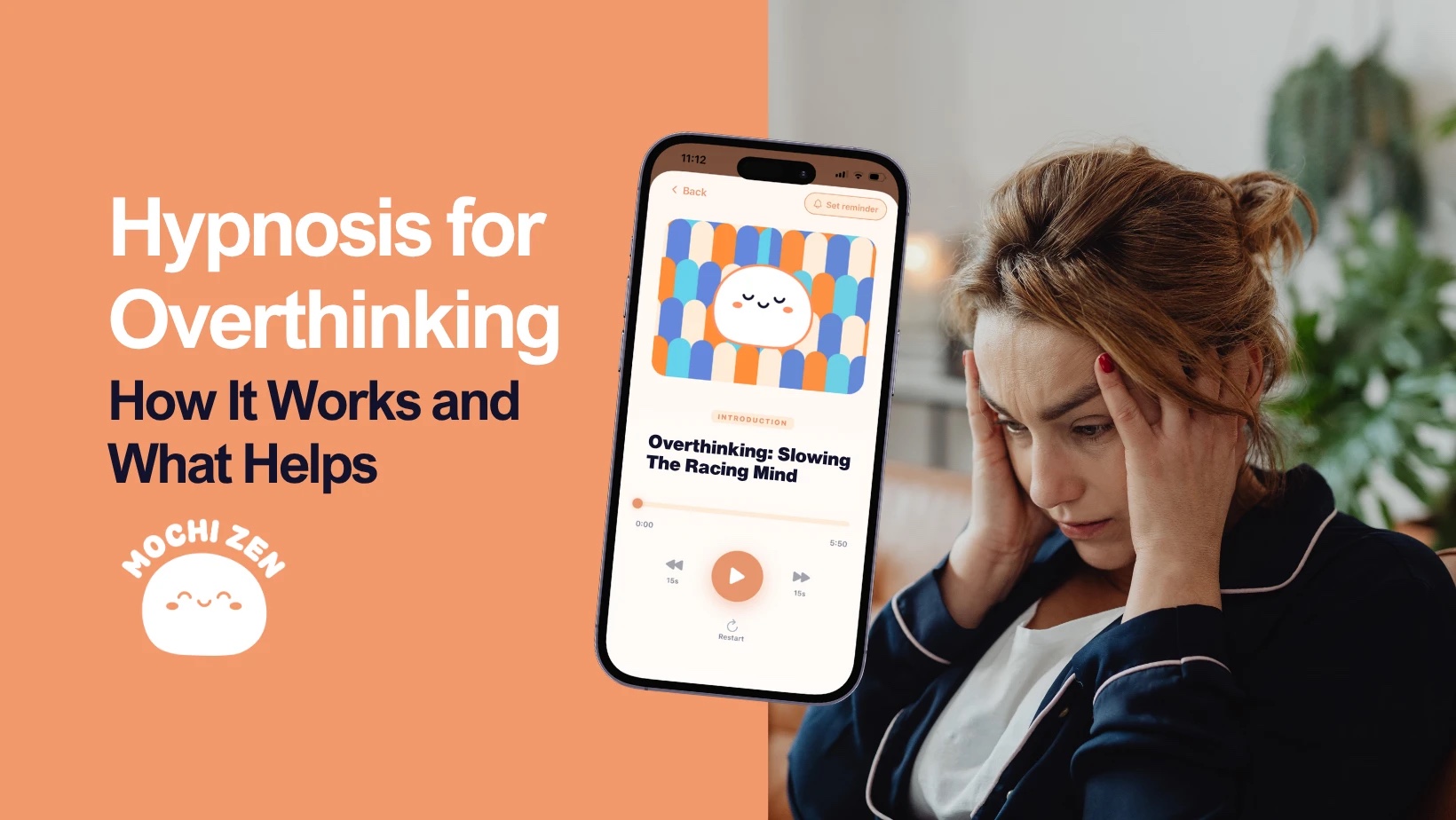
Yes, hypnosis can help with overthinking for many people. Research shows it reliably lowers anxiety, and overthinking is one of the most common ways anxiety shows up, but no study has tested hypnosis on overthinking alone, so think of it as a promising skill you practice, not a switch someone flips for you.
You know the scene. It's 11:40 at night. Six hours ago you said one slightly awkward thing in a meeting, and you've now replayed it more times than you can count. You know it probably didn't matter. You've told yourself to let it go. Your brain nods politely and plays it again.
I'm Paola Mendez, certified RTT (Rapid Transformational Therapy) hypnotherapist, trained in the method developed by Marisa Peer, and founder of Mochi Zen. Here's how hypnosis works on the overthinking habit, what the research honestly says, how to practice it so it actually works, and what you can do tonight.
Quiet the Racing Mind. Try Mochi Zen Free for 7 Days →
What's in This Article
- Why do I overthink everything?
- How does hypnosis work on overthinking?
- Is listening to a recording the same as self-hypnosis?
- What does the research say about hypnosis for overthinking in 2026?
- How do you stop overthinking tonight?
- When should you talk to a professional?
- Frequently asked questions
Why Do I Overthink Everything?
Because at some point your mind learned that thinking ahead was how you stay safe. Maybe you grew up needing to read the room. Maybe something once caught you completely off guard. Your subconscious drew a simple conclusion: if I think through every possibility, nothing can hurt me by surprise. Then it put that conclusion on autopilot.
Here's the trap. Most of what you worry about never happens. But your subconscious doesn't credit luck or your own ability. It credits the worrying. So every quiet week becomes more proof that overthinking works. That's why "just stop thinking about it" fails. You're asking the thinking part of your mind to overrule a safety habit that lives below it.
Overthinking is a close cousin of catastrophizing, which is the leap straight to the worst outcome. I wrote about that in why your brain catastrophizes.
How Does Hypnosis Work on Overthinking?
Hypnosis works on three things that willpower can't reach.
1. It speaks to the belief, not just the thought
Arguing with each worry is like answering every pop-up on a website that keeps making more. Hypnotherapy goes after the setting that creates them: the belief that worrying keeps you safe. In RTT, we use a relaxed, focused state to find where that belief started and update it to something true for your life now, like "I can handle what comes, and I don't have to rehearse it first."
2. It creates a state where change goes in more easily
Hypnosis isn't sleep and it isn't losing control. It's a calm, absorbed focus, a bit like being lost in a good book. You stay aware the whole time. In that state, the critical voice that usually says "yeah, right" gets quieter, so a new message can land instead of bouncing off.
3. Repetition turns the new message into the new habit
Overthinking got strong through thousands of repetitions. The calmer pattern needs repetition too. Hearing "it's safe to put this down" once is nice. Hearing it every day for a week, while you're relaxed, is how it starts to feel automatic.
Is Listening to a Recording the Same as Self-Hypnosis?
Not quite, and this matters. A review of self-hypnosis research by Eason and Parris (2019) found that self-hypnosis worked best when people learned it as a skill they could do on their own and practiced it at least three times. Studies where it showed no benefit usually had people just listening to someone else's hypnosis recording.
I'm telling you this even though Mochi Zen is an app with recordings, because how you use them changes what you get. Pressing play while you scroll your phone is passive. Here's how to make it active:
- Listen to the same session daily. Repetition is the point, which is why our sessions are built to be heard every day for a week.
- Rate before and after. Give your overthinking a number from 0 to 10 before you press play and again after. You're training yourself to notice the shift.
- Practice when you're calm, not only in a crisis. A skill is easier to learn at the pool than in the ocean.
- Take it with you. When a loop starts during the day, close your eyes, take three slow breaths and repeat the phrase from your session. That's self-hypnosis, and you're doing it on your own.
What Does the Research Say About Hypnosis for Overthinking in 2026?
The research on hypnosis and anxiety is encouraging. In a review of 15 studies, people who used hypnosis felt less anxious than about 79% of people in the comparison groups, and that rose to about 84% at the latest check-in. The American Psychological Association's magazine reports that hypnosis helps with anxiety, along with pain, depression and sleep. And in a Stanford study of 84,395 people using a self-hypnosis app, stress dropped in each of their first 10 sessions.
The honest limits: none of these studies looked at overthinking on its own. The review found hypnosis worked best alongside other kinds of psychological help. The Stanford study tracked how people rated their own stress, with no comparison to people who didn't use the app, and one author co-founded that app. For the full picture, I wrote about whether hypnosis works for anxiety. And if you're comparing tools, I ranked the best apps for overthinking by the kind of loop each one fits.
The Mochi Zen Anxiety program has 11 guided sessions: an intro plus 10 days. Day 9 is "The Future Is Safe: I Can Handle What Comes," and Day 10 is "Overthinking: Slowing The Racing Mind." You listen to one session daily, and a new one unlocks every 7 days. It's $15 a month, and the first 7 days are free.
Teach Your Mind It's Safe to Rest. Start Your Free Week →
How Do You Stop Overthinking Tonight?
Hypnosis works on the root over time. These turn the volume down right now.
- Give your worries an appointment. Pick a 15 to 30 minute "worry window" each day, well before bed. When a worry shows up outside it, jot three words and say, "Not now." In a 2024 study of people with generalized anxiety, two sessions of learning to postpone worry reduced their worrying more than in people still waiting for the same help, and the change held four weeks later.
- Ask, "What would I tell a friend?" Imagine your best friend saying your exact thought to you. Whatever you'd say back, say it to yourself.
- Come back to the room you're in. Press your feet into the floor, hold something cold, and name three things you can see. For a fuller version, use my 3-step anxiety spiral technique.
- Write the open loops down, specifically. In a Baylor University sleep lab study, young adults who spent five minutes writing a to-do list before bed fell asleep faster than those who wrote about what they'd already finished. The more specific the list, the faster they fell asleep.
- Use a 2am rule. Nothing you think after midnight counts as a decision. It goes on the paper for morning you. If sleep is the bigger struggle, start with why you can't sleep.
- Downshift your body first. Breathe in for four and out for six or eight, for a couple of minutes. Unclench your jaw and drop your shoulders. For more body-first ideas, see natural remedies for anxiety.
When Should You Talk to a Professional?
If overthinking takes up hours of your day, keeps you awake most nights, or comes with panic attacks, low mood or hopelessness, please talk to a doctor or a licensed mental health professional. These can be signs of an anxiety disorder or depression, and both are very treatable. If you're having thoughts of not wanting to be here, call or text 988 to reach the 988 Suicide & Crisis Lifeline in the US, any time.
Frequently Asked Questions
Can hypnosis help with overthinking?
Hypnosis can help many people with overthinking. Research shows it reliably lowers anxiety, and overthinking is one of the most common ways anxiety shows up. No study has tested hypnosis on overthinking alone, and hypnotherapy is a wellness tool, not a replacement for medical care. Individual results vary.
How does hypnotherapy work for overthinking?
Hypnotherapy works on the belief underneath the habit, usually that worrying keeps you safe. In a calm, focused state, that belief can be found and updated, and repeating the new message daily helps it become the new automatic pattern.
Can I use self-hypnosis to stop overthinking?
Yes. Self-hypnosis works best when you practice it as a skill rather than just listening passively. Use the same session daily, rate your overthinking before and after, practice when you're calm, and repeat your session's phrase when a loop starts.
Does hypnosis help with racing thoughts?
Many people find that hypnosis slows racing thoughts because it calms the body and focuses attention. For fast relief, breathe out longer than you breathe in, press your feet into the floor and name what you can see.
How do I stop overthinking at night?
Spend five minutes writing a specific list of what's unfinished and what you'll do tomorrow, then close the notebook. Use a 2am rule: nothing you think after midnight counts as a decision. Slow your breathing before you try to settle your mind.
How long does hypnosis take to work for overthinking?
There's no standard timeline. Some people notice a calmer mind after a single session, while lasting change usually takes repetition over several weeks.
Disclaimer: This post is for informational purposes only and is not medical or mental health advice. Mochi Zen is a wellness tool and does not replace professional care. If you are in crisis in the US, call or text 988. Individual results vary.