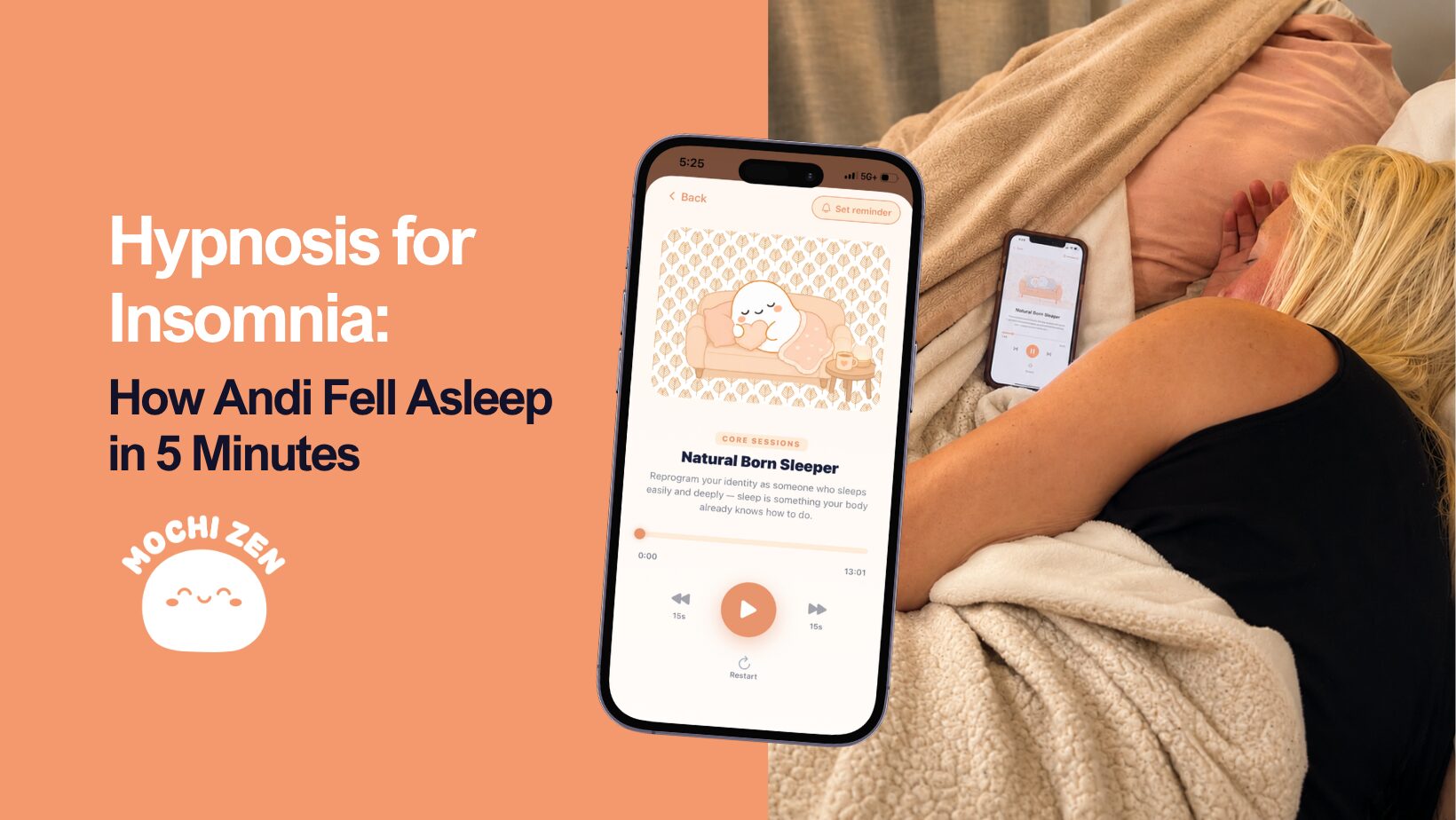
Andi is a Mochi Zen member with complimentary access through our creator partnership. Her story is shared with her permission, and her opinions are her own. Individual results vary.
Every insomniac has a collection. The teas that didn't work. The supplements that worked for a week. The sleep tracker that turned bad nights into graded bad nights. By adulthood, a lifelong insomniac is the world's most qualified skeptic on the subject of things that promise sleep, because she has tried them all and she is still awake.
That is what makes Andi's story worth telling. She came to Mochi Zen as exactly that kind of expert skeptic: an author, storyteller, and photographer whose mind, in her words, has rarely felt like it has an off switch. Anxiety by day, loud thoughts by night, for most of her life. Not a rough season. A lifetime.
Five minutes into her first 20-minute sleep session, she was asleep.
I'm Paola Mendez, certified RTT (Rapid Transformational Therapy) hypnotherapist, trained under the method developed by Marisa Peer, and the founder of Mochi Zen. I have seen a lot of first sessions. This post is about why that one went the way it did, what has happened since, and what the research says about whether hypnosis for insomnia can do this for a mind like yours.
Mochi Zen's RTT-based sleep hypnosis program is designed for nightly listening, in bed, lights off. Full access free for 7 days, no credit card required.
Find Out What Five Minutes Feels Like: Try Mochi Zen Free →What's in this article
A Lifetime of 3am
If you have never had chronic insomnia, here is what it actually costs. Not just the tiredness: the math. Insomniacs do arithmetic all night ("if I fall asleep NOW I can still get four hours") and all day ("I can't commit to that, I won't have slept"). Sleep stops being a place you go and becomes a performance you fail at nightly, in front of the harshest critic in the world: you.
A lifelong insomniac carries something heavier, too: identity. After enough years, "I don't sleep well" stops being a description and becomes a fact about who you are, filed in the subconscious right next to your name. And the mind is loyal to what it believes about you. Every sleepless night becomes evidence; every night of dread becomes rehearsal. That is the loop I wrote about in Why You Can't Sleep, and it is why trying harder at bedtime so often backfires.
Andi knows that loop from the inside, and the way she describes it says everything about why her nights were loud:
"Living with anxiety for most of my life has meant rarely feeling like my mind has an off switch. Even when everything around me is quiet, my thoughts can still be incredibly loud. For me, nighttime has often been when all of the things I managed to carry during the day suddenly ask to be felt at once."
The First Session
Andi pressed play on a 20-minute RTT-based sleep session. The design of those first minutes matters, so here is what they do: the voice gives your attention one soft thing to follow, the breath slows on its own, and the analytical mind (the one doing the sleep math) finds it has nothing to grip. There is no instruction to sleep, because instruction is effort and effort is the enemy. There is only permission.
Five minutes in, she was asleep. Her word for what had just happened: that had never happened before. Not once, in a lifetime of trying everything.
I want to be careful here, because I am a hypnotherapist, not a magician. A first-session response that fast is a wonderful start, not a cure, and not everyone's first night looks like hers. What it demonstrates is something most insomniacs have stopped believing: their body still knows how to fall asleep. The skill was never lost. It was buried under the noise.
Why Can a Lifelong Pattern Shift So Fast?
It sounds impossible: decades of insomnia, dented in twenty minutes. But it makes sense once you see what chronic sleeplessness usually is. Not broken sleep machinery; a hyperactive guard at the gate. The insomniac's mind has learned to treat lights-out as its cue for vigilance (processing, planning, protecting), and that learned response fires automatically no matter how exhausted the body is.
Hypnosis speaks to the guard directly. In the deeply relaxed state a session creates, the vigilance system stands down, and for many people the body does the thing it has been waiting years for permission to do. The lasting change then comes from repetition: each night the session runs, the new association (bed means release, not review) gets rehearsed, and neuroplasticity turns the rehearsal into wiring. It is the same daily-practice principle behind Sharonda's food-noise story: one member, one session, every day, until the mind's default changed.
What Has Happened Since
The first night was not a fluke she chased and lost. Andi now listens every single night, and her verdict on the program is the phrase every builder dreams of hearing from a lifelong skeptic: life-changing. Here is how she describes her nights now:
"Mochi Zen has become part of the way I tell my mind that the day is over. I put it on at night, close my eyes, and instead of feeling like I have to fight my thoughts into silence, I have something gentle to follow. It has turned bedtime into a ritual I genuinely look forward to."
Notice what is missing from that description: fighting. After a lifetime of wrestling her mind toward sleep, the practice replaced the fight with a ritual. Andi wrote about her whole experience in her own words, and if her story resonates, her telling of it is worth your time: read Andi's full review here.
Bedtime as a ritual to look forward to, not a fight to lose. That is what nightly listening builds.
Sleep Like It Was Never a Fight: Start Your Free Week →What Does the Research Say About Hypnosis for Insomnia?
One member's night is a story. The reason I built a sleep program at all is that the research points the same direction. In a controlled study published in the journal Sleep (Cordi et al., 2014), hypnotic suggestion increased slow-wave sleep (the deep, restorative kind) by 81% and reduced time spent awake by about two-thirds, with no adverse effects. The Sleep Foundation recognizes sleep hypnosis as a legitimate, low-risk complement to standard care. I explain how those findings translate into a nightly program on the sleep hypnotherapy for insomnia page.
If You Have Tried Everything Too
Andi's playbook is repeatable, and it is not complicated. Press play at bedtime, in bed, lights off. Let the session be the last thing your mind holds. If you fall asleep in five minutes, wonderful; if you drift at minute nineteen, that counts exactly the same, because the mind keeps processing as you go. Repeat nightly, same program, for at least two weeks before you judge it. And if your sleeplessness travels with anxiety, as it does for most of the insomniacs I meet, the same membership covers the anxiety program too, because a racing mind at midnight and a racing mind at noon are usually the same mind.
For deeper one-on-one work on what your mind guards at night, I see private clients at Pao Hypnosis, in Miami and remotely. And if the nights themselves feel like the ones my practice's post describes, start there: the anxiety-insomnia cycle.
A lifetime of insomnia does not need a lifetime to change. Sometimes it needs twenty minutes, pressed play on enough nights in a row.
Your body still knows how to fall asleep. The skill was never lost; it is buried under the noise, and the noise can be quieted.
Give Your Mind Permission to Sleep: Try Free for 7 Days →Frequently Asked Questions
Can hypnosis really help lifelong insomnia?
Chronic insomnia is usually a learned vigilance pattern, not broken sleep machinery, and learned patterns can be retrained at any age. Hypnosis works on that pattern directly. Research shows measurably deeper sleep from hypnotic suggestion, and results build with nightly repetition. Individual results vary.
How fast does hypnosis for insomnia work?
Some people, like Andi, respond in the very first session; for others the shift arrives gradually across one to three weeks of nightly listening. The durable change comes from repetition either way.
What if it doesn't knock me out in five minutes?
A fast first night is a bonus, not the benchmark. The session is working whether you drift at minute five or stay aware to the end, because the suggestions are rehearsing a new association between bed and release each time you listen.
Do I listen lying down? What if I fall asleep mid-session?
Yes, listen in bed at bedtime, and falling asleep mid-session is the intended outcome. Your mind continues processing as you drift.
Is this a replacement for sleep medication or medical care?
No. Hypnosis is a complementary approach. If your insomnia may have a medical cause, or you are considering changing any medication, talk to your doctor. The two approaches work fine alongside each other.
Why did a skeptic respond so well?
Skepticism is a thinking-mind position, and hypnosis does not require the thinking mind's agreement, only its rest. Many skeptics respond strongly precisely because their analytical mind is exhausted from years of overwork at bedtime.
What program did Andi use?
The Mochi Zen insomnia program: RTT-based sleep sessions designed for nightly listening, included in the standard membership along with the anxiety and weight loss programs. A 7-day free trial is available with no credit card.
Does hypnosis help you stay asleep through the night?
The strongest research finding is about sleep architecture: 81% more slow-wave sleep and about two-thirds less time awake in a controlled study. That is the stay-asleep problem specifically.
Disclaimer: This post is for informational purposes only and is not a substitute for professional medical care. Andi's experience is her own; individual results vary. Persistent insomnia can have medical causes; please consult a qualified healthcare provider.