Table of Contents
- Why Willpower Isn’t the Problem
- What’s Really Driving Your Overeating
- Why Traditional Approaches Keep Failing
- The Root Cause: Your Subconscious Mind
- How to Actually Stop Overeating for Good
- When to Seek Professional Help
- Frequently Asked Questions

You’ve tried tracking calories. You’ve done the meal prep. You’ve started over on Monday more times than you can count, and by Thursday you’re standing in the kitchen eating things you swore you wouldn’t touch. And the worst part? You don’t even know why.
Here’s what most diet advice will never tell you: overeating is rarely about food. It’s about what’s happening beneath the surface, in your subconscious mind, and until you address that, no app, meal plan, or motivational pep talk is going to fix it for good.
This article breaks down the real root cause of overeating and what actually works to stop it.
Already know you need a new approach?
Stop Fighting Cravings: Try Mochi Zen Free for 7 Days →
The only app that combines RTT-based hypnotherapy with smart nutrition tracking to fix why you overeat, not just what you eat.
Why Willpower Isn’t the Problem
Let’s get this out of the way first: if you’ve struggled to stop overeating, it is not because you lack discipline. It is not because you don’t care enough. And it is absolutely not a character flaw.
Research consistently shows that willpower is a finite, unreliable resource, especially when you’re stressed, tired, or emotionally depleted. And if you’ve ever eaten your way through an entire evening after a hard day at work, you already know this firsthand.
The diet industry has made billions convincing you that the answer is more structure, more rules, and more restriction. But restriction triggers its own cycle: deprivation leads to craving, craving leads to overeating, overeating leads to guilt, guilt leads to more restriction. Around and around it goes.
If willpower were the answer, you would have solved this already.
What’s Really Driving Your Overeating
Overeating, especially the kind that feels compulsive or out of your control, is almost always rooted in emotional triggers. Stress. Boredom. Loneliness. Anxiety. Even celebration.
Your brain has learned to use food as a coping mechanism. When something difficult happens, your nervous system searches for relief, and if food has historically provided that relief, your brain will keep reaching for it automatically. This is not weakness. This is conditioning.
The science backs this up. Cortisol, your primary stress hormone, directly increases appetite and cravings for high-fat, high-sugar foods. Dopamine, the brain’s reward chemical, spikes when you eat those foods, reinforcing the behavior every single time. Your brain is literally rewarding you for overeating.
This is why approaches that only address what you eat never fully work. They don’t touch the emotional and neurological patterns that are driving the behavior in the first place.
Related: Why You Can’t Stop Binging at Night (And What to Do About It)
Why Traditional Approaches Keep Failing
Here’s an honest look at the most common solutions, and why they fall short:
Calorie counting apps
Tracking what you eat has real value (more on that in a moment), but logging a binge after it happens doesn’t prevent the next one. These apps tell you what you ate. They do nothing about why.
Food psychology programs
Assigning foods a color or a score doesn’t rewire the subconscious beliefs that make you reach for them when you’re stressed, lonely, or exhausted. You can know intellectually that something isn’t good for you and still eat it compulsively. Knowing isn’t the problem.
Diets and meal plans
Restriction is the fastest route to obsession. The more you tell your brain certain foods are forbidden, the more intensely it will crave them. This is basic psychology, and it’s exactly why most diets unravel within weeks.
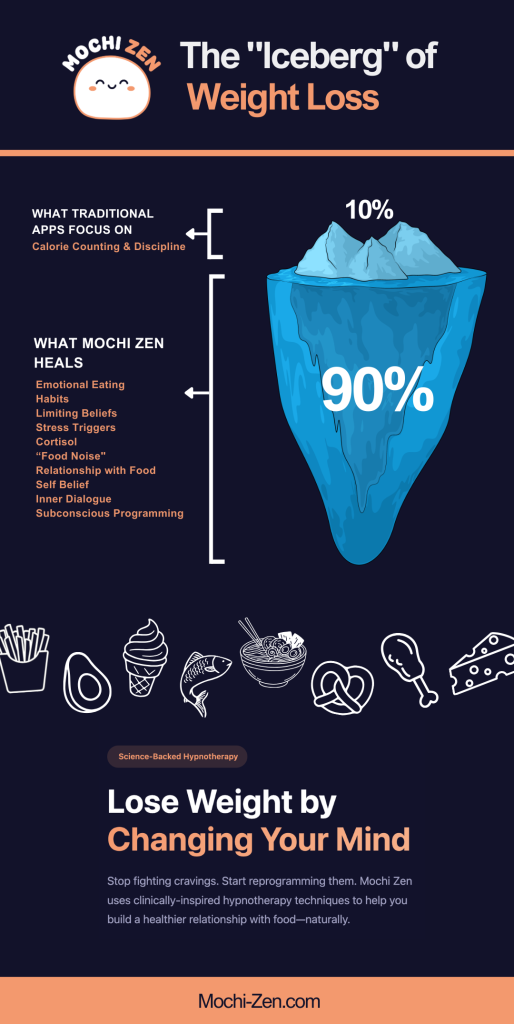
The missing piece in every one of these approaches is the same thing: the subconscious mind.
The Root Cause: Your Subconscious Mind
Rapid Transformational Therapy (RTT), developed by world-renowned therapist Marisa Peer, is built on one powerful insight: the behaviors we can’t change through conscious effort are almost always driven by subconscious programming: beliefs and patterns formed earlier in life that continue to run quietly in the background, without our awareness.
When it comes to overeating and emotional eating, those subconscious programs might sound like:
- “Food is how I comfort myself when things go wrong.”
- “I eat when I’m bored because I don’t know what else to do with myself.”
- “I deserve to treat myself: food is the one thing that’s just for me.”
These aren’t thoughts you consciously choose. They’re automatic. And no amount of meal planning changes them.

RTT uses hypnotherapy to access and rewire these patterns, not through force or willpower, but by helping your mind understand where the behavior started and create new, healthier associations at the subconscious level.
The research supports this approach. A landmark study by Kirsch, Montgomery, and Sapirstein (1995), published in the Journal of Consulting and Clinical Psychology, found that patients who used hypnotherapy lost more than twice the weight of those who didn’t, and those results held at a two-year follow-up. (Source: PubMed)
Ready to stop fighting your subconscious and start working with it?
Start Your Free 7-Day Trial of Mochi Zen →
How to Actually Stop Overeating for Good
Here’s what a sustainable approach looks like: one that addresses the psychological root cause and the practical nutrition side together.
Step 1: Identify your emotional triggers
Start noticing when you overeat, not just what you eat. Is it after work? When you’re anxious? When you’re alone at night? Naming the trigger is the first step to breaking the automatic response.
Step 2: Interrupt the pattern before it runs
Before reaching for food, pause for ten seconds and ask yourself: Am I physically hungry right now, or am I looking for something else? This simple check doesn’t require willpower; it just requires a moment of awareness.
Step 3: Rewire the subconscious pattern
This is where hypnotherapy changes the game. RTT audio sessions work while you’re in a deeply relaxed state, delivering new messaging directly to the subconscious mind, replacing old, self-defeating patterns with new beliefs about food, your body, and what you actually need. Many people notice a shift in their cravings and emotional eating patterns after just a few sessions.
Step 4: Pair it with mindful nutrition awareness
Once the emotional drive to overeat begins to quiet down, having a clear picture of what you’re actually eating becomes genuinely useful, not as punishment, but as information. Understanding your macros, logging meals without obsession, and tracking your progress gives you the data to make adjustments from a place of curiosity rather than shame.
This is the exact approach inside Mochi Zen, the only weight loss app that combines RTT-based hypnotherapy audio sessions with AI-powered nutrition tracking in one place. It was built by Paola Mendez, RTT-certified and trained by Marisa Peer, specifically for women who have tried everything else and are ready to fix the root cause.

When to Seek Professional Help
If your overeating feels completely out of control, is causing significant distress, or meets the criteria for Binge Eating Disorder (BED), please consider working with a licensed therapist or eating disorder specialist alongside any app-based support. Paola Mendez also offers private one-on-one RTT sessions through Pao Hypnosis for women who want personalized, in-depth work.
Frequently Asked Questions
Why do I keep overeating even when I’m not hungry?
Overeating when you’re not physically hungry is almost always tied to emotional triggers: stress, boredom, loneliness, or anxiety. Your brain has learned to use food as a coping tool, and that pattern is driven by the subconscious mind, not actual hunger signals. Addressing those underlying triggers is what creates lasting change.
Can overeating be a mental health issue?
Yes. Emotional eating and Binge Eating Disorder (BED) are recognized psychological conditions. If overeating is causing you significant distress or feels genuinely out of your control, speaking with a mental health professional is a valuable and important step.
How long does it take to stop overeating?
It depends on the person and the approach. Willpower-based methods rarely produce lasting results. Approaches that address the subconscious root cause, like RTT hypnotherapy, tend to work faster and more durably, with many people noticing a real shift in their relationship with food after just a few sessions.
Does hypnotherapy actually work for overeating?
Yes, and the research supports it. A 1995 study by Kirsch, Montgomery, and Sapirstein in the Journal of Consulting and Clinical Psychology found that patients using hypnotherapy lost more than twice the weight of a control group, and those results held at a two-year follow-up. RTT, developed by Marisa Peer, builds on this foundation to target the specific subconscious patterns driving emotional eating.
What’s the difference between overeating and binge eating disorder?
Overeating refers broadly to eating more than your body needs, often triggered by emotions or habits. Binge Eating Disorder (BED) is a clinical diagnosis characterized by recurrent episodes of eating very large amounts of food rapidly, a feeling of being out of control during the episode, and significant distress afterward. If you suspect you may have BED, please seek professional support.
Is emotional eating the same as overeating?
Emotional eating is one of the most common causes of overeating, but not the only one. You can overeat for other reasons: distracted eating, large portions, social pressure. Emotional eating specifically means using food to manage or numb emotions rather than to satisfy physical hunger.
What’s the fastest way to stop overeating for good?
The fastest sustainable approach is to address both the emotional root cause and your food awareness at the same time, which is why pairing RTT hypnotherapy with nutrition tracking works so much better than either approach alone. Quick fixes like strict diets tend to backfire by triggering the restrict-binge cycle.
About the Author
Paola Mendez is a certified hypnotherapist and Rapid Transformational Therapy (RTT) practitioner, trained in the methodology developed by Marisa Peer. She is the founder of Mochi Zen, a weight loss app combining RTT-based hypnotherapy with AI-powered nutrition tracking, and Pao Hypnosis, her private practice. She specializes in helping women break free from emotional eating, chronic dieting, and the self-sabotage patterns that keep them stuck.
Stop Fighting Cravings: Try Mochi Zen Free for 7 Days
The only app that fixes why you overeat AND tracks what you eat. No willpower required. Start Your Free Trial →
Health Disclaimer: The content in this article is for informational purposes only and is not a substitute for professional medical or psychological advice, diagnosis, or treatment. RTT-based hypnotherapy is a complementary approach and should not replace care from a qualified healthcare provider. If you are experiencing symptoms of an eating disorder, please consult a licensed professional.