Table of Contents
- What Binge Eating Actually Is (And What It Isn’t)
- Why Binge Eating Keeps Happening
- The Restrict-Binge Cycle (And How to Break It)
- What Doesn’t Work (And Why)
- The Root Cause Most Approaches Miss
- How to Actually Get Over Binge Eating
- When to Seek Professional Support
- Frequently Asked Questions

You tell yourself today is different. You eat well all morning. You’re doing great. And then, almost without warning, you’re standing over the kitchen counter eating things you swore you wouldn’t touch, and you don’t even fully remember deciding to start.
Afterward comes the guilt. The shame. The promise to yourself that tomorrow you’ll be better. And the exhausting, demoralizing cycle starts again.
If this sounds familiar, here’s the most important thing you can know: binge eating is not a willpower problem. It never was. And that’s exactly why trying harder hasn’t worked.
Done trying to out-willpower your cravings?
Try Mochi Zen Free for 7 Days →
The only app that combines RTT-based hypnotherapy with smart nutrition tracking to address the root cause of binge eating, not just the symptoms.
What Binge Eating Actually Is (And What It Isn’t)
Binge eating is broadly defined as eating a large amount of food in a short period of time while feeling a loss of control. That loss-of-control feeling is key: it’s what separates binge eating from simply overeating at a big meal or treating yourself on a special occasion.
Binge Eating Disorder (BED) is a formal clinical diagnosis, the most common eating disorder in the United States, more prevalent than anorexia and bulimia combined, according to the National Institute of Mental Health. But you don’t need a formal diagnosis to recognize that your relationship with food feels out of control and causing you real distress.
What binge eating is not:
- A sign that you’re weak or lack discipline
- Something that can be fixed by eating less or trying harder
- Just “bad habits” that a meal plan will resolve
- Your fault
Understanding what binge eating actually is (a pattern driven by the subconscious mind, not a character flaw) is the first step to getting over it.
Why Binge Eating Keeps Happening
Here’s what’s actually going on beneath the surface when binge eating feels unstoppable.
Your brain is running an automatic program
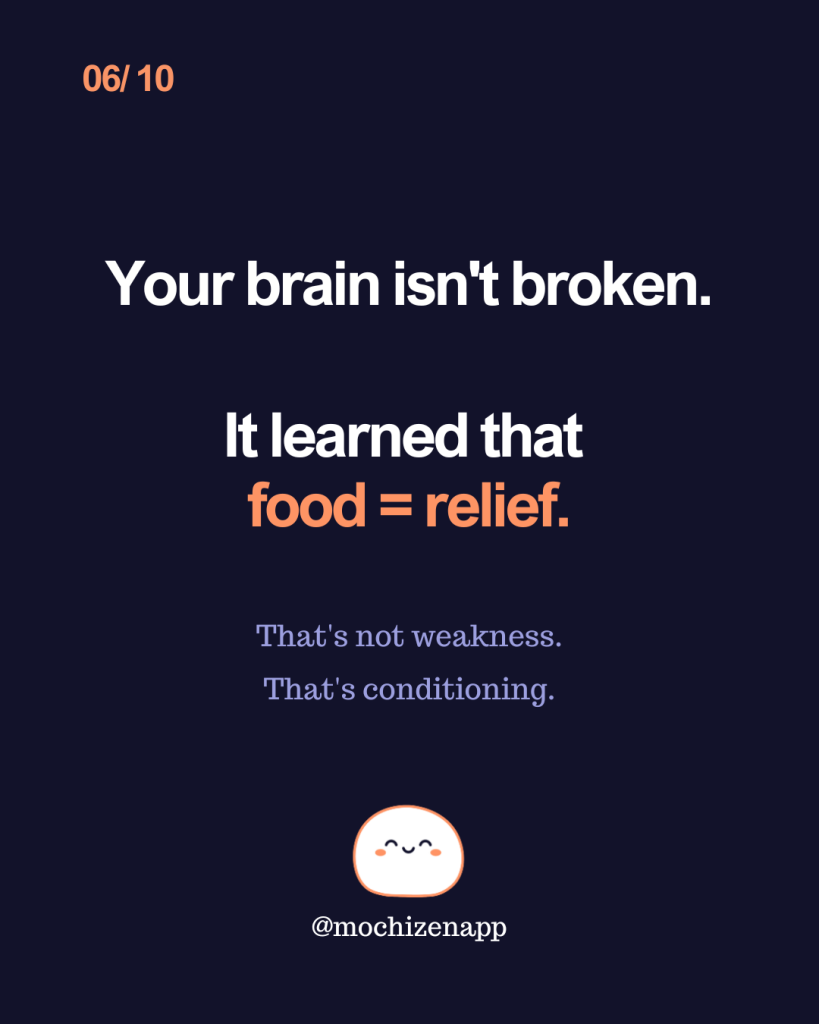
At some point (often in response to stress, emotional pain, restriction, or a learned association formed early in life) your brain created a shortcut: food = relief. Once that pattern is encoded in the subconscious, it runs automatically. You don’t decide to binge. The program just runs.
Stress hormones are working against you
When you’re stressed, anxious, or emotionally overwhelmed, your body releases cortisol, a hormone that directly increases cravings for high-sugar, high-fat foods. This isn’t a lack of self-control. It’s biology. And it means that the more stressed you are, the harder your body works to push you toward exactly the foods you’re trying to avoid.
Restriction makes it worse
The more you restrict certain foods, the more your brain fixates on them. Deprivation amplifies desire, and when the willpower eventually runs out (as it always does), the pendulum swings hard in the other direction. This is not failure. This is a predictable, documented physiological and psychological response to restriction.
Related: How to Stop Overeating for Good: The Root Cause No One Talks About
The Restrict-Binge Cycle (And How to Break It)
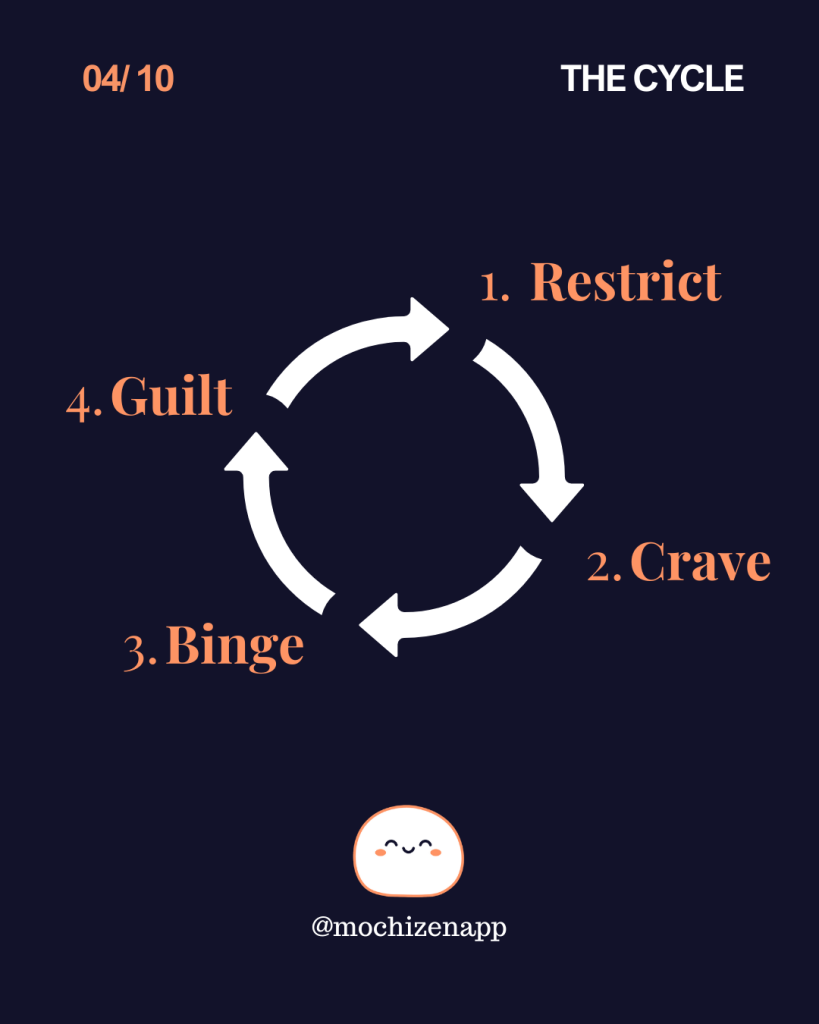
Most people who struggle with binge eating are trapped in a cycle that looks something like this:
- Restrict: cut out certain foods, follow a strict plan, try to “be good”
- Crave: the restriction increases obsessive thoughts about food
- Break: willpower depletes, a trigger hits, the binge happens
- Guilt: shame and self-criticism take over
- Restrict again: “I’ll be stricter tomorrow”, and the cycle restarts
The cruel irony is that the restriction itself is what fuels the binge. You can’t diet your way out of binge eating. The solution isn’t more control; it’s understanding what’s driving the loss of control in the first place.
Breaking the cycle requires interrupting it at the root: the subconscious beliefs and emotional triggers that start the whole sequence.
What Doesn’t Work (And Why)
If you’ve been struggling with binge eating for a while, you’ve probably tried some version of these approaches:
“Just eat intuitively”
Intuitive eating is a valuable framework, but when binge eating is driven by deeply conditioned subconscious patterns, telling someone to “listen to their body” can feel impossible. The subconscious program is louder than the body’s signals.
Tracking and logging
Food tracking can be a useful tool, but for someone in a binge-restrict cycle, it often reinforces the obsession with food rather than easing it. Tracking works best once the emotional underpinning of the behavior has been addressed.
Cognitive behavioral strategies alone
Awareness-based approaches help, but they primarily engage the conscious mind. Binge eating is largely a subconscious behavior. Conscious strategies can interrupt the cycle temporarily, but they rarely rewire the underlying pattern.
More willpower
Already covered this, but it bears repeating. Willpower is a depleting resource. Using it as your primary strategy for managing binge eating is like trying to bail out a boat without fixing the hole.
What if the answer wasn’t more control, but less resistance?
See How Mochi Zen Works: Try Free for 7 Days →
The Root Cause Most Approaches Miss
Rapid Transformational Therapy (RTT), developed by world-renowned therapist Marisa Peer, identifies binge eating as a subconscious coping mechanism, one that typically develops in response to unmet emotional needs, stress, or early experiences with food and body image.
Until the subconscious program is updated, behavioral strategies will only go so far. You can change what you eat. You can change when you eat. But if the underlying belief (“I need food to feel okay”) is still running in the background, the behavior will keep reasserting itself.
RTT-based hypnotherapy works differently. It accesses the subconscious mind in a deeply relaxed state and helps you identify the root of the pattern, understand it without judgment, and replace it with a new, healthier response. It doesn’t use willpower. It doesn’t rely on restriction. It changes the program itself.
Research backs this up: a landmark study by Kirsch, Montgomery, and Sapirstein (1995), published in the Journal of Consulting and Clinical Psychology, found that patients using hypnotherapy as part of their treatment lost more than twice the weight of those who didn’t, with results that held at a two-year follow-up. (Source: PubMed)
How to Actually Get Over Binge Eating

Recovery from binge eating isn’t about perfect eating. It’s about changing your relationship with food at the level where the behavior actually lives: the subconscious. Here’s what that looks like in practice:
Step 1: Stop restricting

This feels counterintuitive, but it’s essential. As long as you’re in a restriction mindset, the binge-restrict cycle has fuel. Removing the restriction removes the pressure that makes binges inevitable. This doesn’t mean eating everything in sight; it means releasing the all-or-nothing thinking around food.
Step 2: Get curious about your triggers
Start noticing what happens just before a binge. What were you feeling? What were you thinking? What happened that day? You’re not trying to stop the binge through awareness alone; you’re building a map of the emotional terrain so you can address it at the source.
Step 3: Address the subconscious pattern directly
This is the step most approaches skip entirely. Hypnotherapy audio sessions, like those inside Mochi Zen, work while you’re in a relaxed, receptive state to deliver new messaging to the subconscious mind. Over time, the automatic program begins to change. The urge to binge softens. Food starts to feel neutral rather than emotionally charged.
Step 4: Rebuild a neutral relationship with food
Once the emotional charge around food begins to ease, it becomes possible to track, log, and plan your nutrition without it becoming an obsession. Mochi Zen pairs Hypnotherapy audio sessions with AI-powered nutrition tracking so you can do both (address the root cause and build practical food awareness) in one place.
This is what a sustainable path out of binge eating looks like. Not more rules. Not more restriction. A genuine change in the beliefs that have been running the show.
When to Seek Professional Support
If your binge eating is frequent, causing significant physical or emotional distress, or accompanied by purging behaviors, please reach out to a licensed eating disorder specialist or therapist. App-based support is a powerful complement to professional care, but it is not a replacement when clinical-level support is needed.
For women who want personalized, one-on-one RTT work alongside or instead of an app, Paola Mendez offers private sessions through Pao Hypnosis.
Frequently Asked Questions
Can you get over binge eating on your own?
Many people do make significant progress without formal clinical treatment, especially when they address the emotional and subconscious roots of the behavior. However, if binge eating is causing significant distress or is accompanied by other symptoms, working with a professional is always recommended. App-based tools like Mochi Zen can be a strong starting point or a complement to professional support.
How long does it take to get over binge eating?
It varies widely depending on the individual, the severity of the pattern, and the approach used. Willpower-based approaches rarely produce lasting results. Approaches that address the subconscious, like RTT hypnotherapy, often show faster, more durable results, with many people noticing meaningful change within a few weeks.
Is binge eating a form of addiction?
The neurological mechanisms of binge eating share similarities with addiction: dopamine reward loops, compulsive behavior, and loss of control. While it isn’t classified as an addiction in the same way substance disorders are, it responds well to approaches that target subconscious conditioning, much like addiction treatment does.
What triggers binge eating?
Common triggers include stress, boredom, loneliness, anxiety, fatigue, and emotional pain. Food restriction itself is also a major trigger. The specific triggers vary by person, which is why identifying your personal emotional landscape is a key part of recovery.
Does hypnotherapy help with binge eating?
Yes. RTT hypnotherapy, developed by Marisa Peer, specifically targets the subconscious patterns that drive binge eating: the beliefs and emotional associations that keep the behavior running automatically. Research by Kirsch et al. (1995) supports the effectiveness of hypnotherapy as a weight management tool, and many RTT practitioners work specifically with binge eating and emotional eating.
What’s the difference between binge eating and emotional eating?
Emotional eating means using food to manage emotions: eating when stressed, sad, or bored rather than physically hungry. Binge eating specifically involves a loss of control and consuming unusually large amounts of food, often rapidly. Emotional eating is frequently a component of binge eating, but not all emotional eating qualifies as a binge.
Can stress cause binge eating?
Yes, stress is one of the most common binge eating triggers. Cortisol (the stress hormone) increases appetite and specifically drives cravings for high-sugar, high-fat foods. Chronic stress keeps cortisol elevated, which means the urge to binge can feel near-constant. Addressing stress at the nervous system level, not just through behavioral strategies, is a critical part of recovery.
About the Author
Paola Mendez is a certified hypnotherapist and Rapid Transformational Therapy (RTT) practitioner, trained in the methodology developed by Marisa Peer. She is the founder of Mochi Zen, a weight loss app combining RTT-based hypnotherapy with AI-powered nutrition tracking, and Pao Hypnosis, her private practice. She specializes in helping women break free from binge eating, emotional eating, and the self-sabotage cycles that keep them stuck.
Ready to Break the Binge Cycle for Good?
Mochi Zen combines RTT-based hypnotherapy with AI nutrition tracking to address the root cause, not just the symptoms. Try it free for 7 days.
Break Free: Start Your Free Trial →
Health Disclaimer: The content in this article is for informational purposes only and is not a substitute for professional medical or psychological advice, diagnosis, or treatment. If you are experiencing symptoms of Binge Eating Disorder or any other eating disorder, please consult a licensed healthcare provider. RTT-based hypnotherapy is a complementary approach and should not replace professional clinical care.