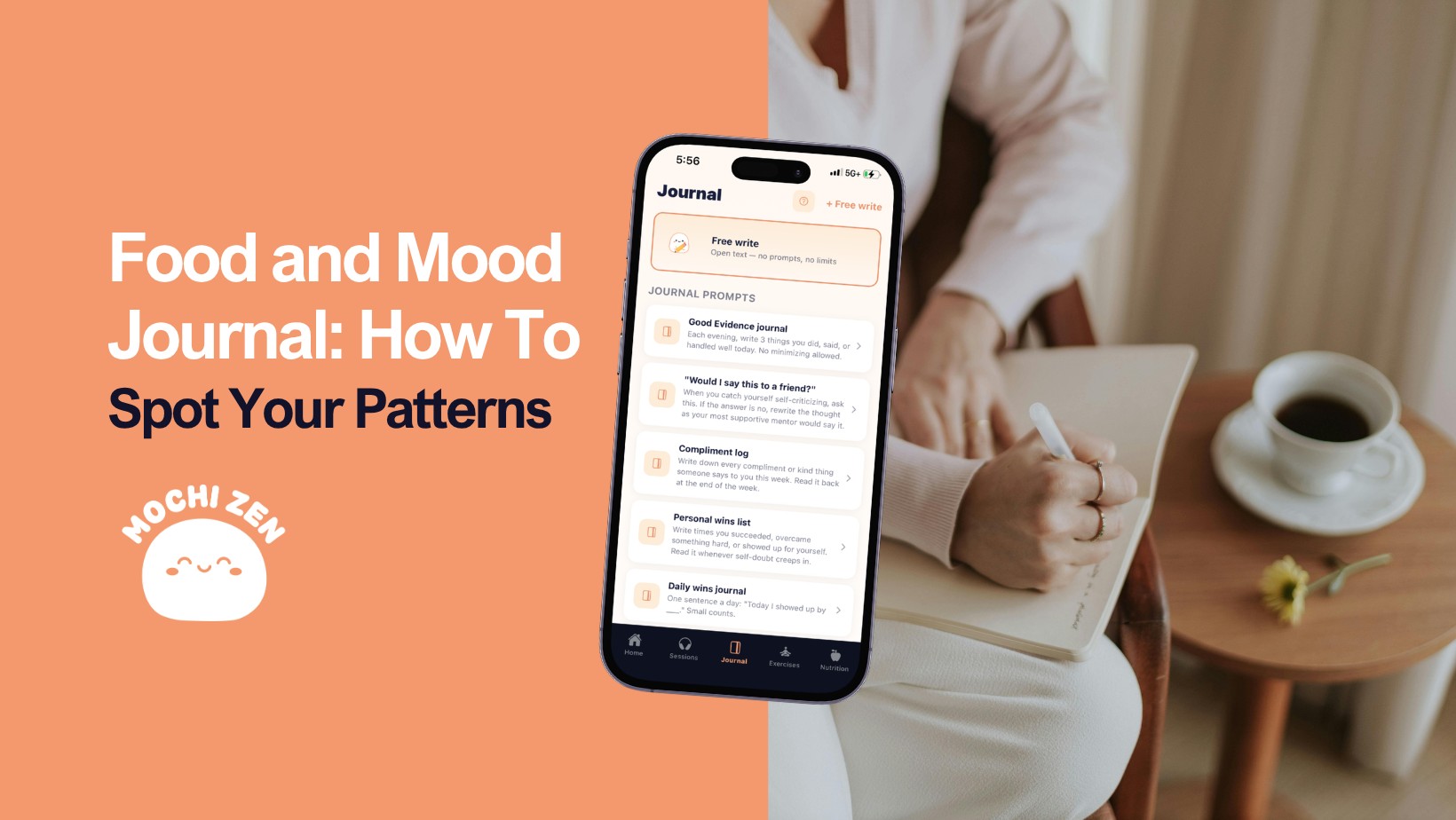
A food and mood journal is a simple log of what you eat next to how you felt and what you were thinking. Kept for a week or two, it shows patterns you can't see in the moment, like the stressful afternoon that always ends at the vending machine. Research suggests food, mood, stress and sleep affect each other in both directions, and a journal shows you how that plays out for you.
I'm Paola Mendez, a certified RTT (Rapid Transformational Therapy) hypnotherapist and the founder of Mochi Zen. People ask why a hypnotherapy app for anxiety, insomnia and burnout has nutrition tools. My answer: what we eat affects what we think, and what we think affects the eating choices we make. Keeping track of both helps us find the patterns that keep us stuck.
What's in This Article
- What Is a Food and Mood Journal?
- What Does Research Say About How Food Affects Mood?
- Why Your Thoughts Change Your Food Choices
- What to Track: A Simple Food and Mood Journal Template
- How to Spot Patterns After One or Two Weeks
- When Tracking Backfires
- How Mochi Zen Makes It Easy
- Frequently Asked Questions
What Is a Food and Mood Journal?
It's a mood and food diary with one twist: you write down your inner world, not just your plate. A regular food log tells you what you ate. A food and mood journal also tells you how you felt before and after, what was on your mind, how you slept and how stressed you were.
The goal isn't to judge your meals. It's to collect clues. One entry tells you almost nothing. Fourteen days of entries tell a story.
What Does Research Say About How Food Affects Mood?
The link is real, but some parts are much better supported than others. Here's what I'd stand behind.
Better eating helped people with depression in a trial. In the SMILES trial in Australia, 67 adults with moderate to severe depression were split into two groups for 12 weeks. One group got seven sessions with a dietitian to improve their diet. The other got the same number of friendly social support visits. At the end, about 32% of the diet group no longer met the threshold for depression, compared with 8% of the social support group (Jacka et al., 2017). It was a small study, people knew which group they were in, and most were already getting other treatment, so it's encouraging rather than final.
The bigger picture is promising for low mood, less clear for anxiety. A 2019 review that pooled 16 trials with more than 45,000 people found that improving diet reduced symptoms of depression. For anxiety, the same review found no clear effect (Firth et al., 2019). So when it comes to the food and anxiety connection, food is one piece of the puzzle, not a cure.
Daily diaries show day-to-day links. In one study, 281 young adults kept an online food and mood diary for 21 days. On days they ate more fruit and vegetables, they tended to feel calmer and happier, and eating more of them predicted a slightly better mood the next day (White, Horwath and Conner, 2013). It shows a connection, not proof of cause, but it's a good example of what a journal can reveal.
What about the gut-brain connection? Your gut and your brain are in constant conversation. Scientists have mapped real communication routes between them, including the vagus nerve and signals from the bacteria that live in your gut (Cryan et al., 2019). Researchers are still learning exactly how it works in people, but it is one more reason that noticing how your meals and your moods line up is worth doing.
Why Your Thoughts Change Your Food Choices
This is the part I see every day as a hypnotherapist. The arrow points both ways.
Stress changes what we reach for. In the American Psychological Association's 2013 Stress in America survey, 38% of adults said they had overeaten or eaten unhealthy foods in the past month because of stress, and 30% said they had skipped a meal because of stress (APA, 2013). Stress pushes some people to eat more and others to eat less, which is why your own journal matters more than general rules.
Poor sleep changes what looks good. In a sleep lab study, 23 healthy young adults rated pictures of food after a normal night and after a night without sleep. After the sleepless night, they wanted more high-calorie foods and brain areas involved in weighing choices were less active, even though they weren't hungrier (Greer, Goldstein and Walker, 2013). More on that in why you can't sleep.
Beliefs run in the background. In RTT, we look at the thoughts underneath the habit. "I deserve a treat after a day like this." "There's no time to eat properly." Written next to your meals, those thoughts stop being invisible. If anxiety shows up right after meals, read about anxiety after eating, which goes deeper into that specific loop.
What to Track: A Simple Food and Mood Journal Template
Keep it light. If it takes more than a minute per entry, you'll stop. Here's the template I suggest:
| What to note | Example |
|---|---|
| Time | 3:40 pm |
| Food and drink | Granola bar, iced coffee |
| Hunger (1 to 10) | 4 |
| Mood before | Tense, rushed |
| Mood after | Wired, then flat |
| Thoughts | "I need something to get through this meeting." |
| Sleep last night | 5 hours, woke at 3 am |
| Stress (1 to 10) | 8 |
A hunger rating is useful because it separates body hunger from everything else. If you're eating at a 3 out of 10, something other than hunger is usually asking for attention.
How to Spot Patterns After One or Two Weeks
After 7 to 14 days, read your entries like a detective, not a judge. Look for repeats:
- Time patterns: Is there a time of day when your mood dips or your cravings spike?
- Sleep patterns: What do the days after a short night look like, for both food and mood?
- Stress patterns: When stress is 7 or higher, do you eat more, skip meals or reach for the same food every time?
- Mood after: Which meals leave you steady, and which leave you jittery, foggy or low?
- Repeating thoughts: Is there a sentence you keep writing? That sentence is often the real pattern.
Pick one pattern to work on, not five. If short sleep keeps leading to anxious days and grazing, start with sleep rather than food. If the same comforting thought keeps showing up, this post on emotional eating may help.
When Tracking Backfires
Tracking is a tool, and it isn't right for everyone. Please stop and talk to a professional if:
- Logging makes you more anxious, guilty or obsessed with food.
- You feel you have to log every bite perfectly, or you panic when you miss one.
- You have a history of an eating disorder, or you're in recovery.
If any of that sounds like you, a doctor, therapist or registered dietitian can help you decide what kind of tracking, if any, is safe. In the US, you can reach the ANAD Eating Disorders Helpline for free support at 888-375-7767. If you're in crisis, call or text 988.
How Mochi Zen Makes It Easy
Most people quit food journals because logging is tedious. In Mochi Zen, you just type or say what happened in a sentence, including what you ate, how you moved and how much water you had, and the app works out your macros and tracks it for you. You can also snap a photo of your meal with the AI meal scan. If you want to know your numbers, there's a free macro calculator too.
Then there's the mood and thoughts side. The guided journal gives you a place to write down what you're feeling and thinking, so your food and your inner world live in the same app.
And once you've found your pattern, the hypnotherapy works on what's underneath it. Mochi Zen has programs for anxiety (11 sessions), sleep and insomnia, burnout (13 sessions), and weight loss and food noise. You listen to each RTT session daily for a week, and a new one unlocks every 7 days. One subscription covers every program.
Ready to see your own patterns?
Log food, mood and thoughts in one place, then work on the root with RTT hypnotherapy. $15/month or $120/year, and your first 7 days are free.
Frequently Asked Questions
What should I write in a food and mood journal?
Write the time, what you ate and drank, your hunger from 1 to 10, your mood before and after, what you were thinking, how you slept and your stress level. Keep each entry short so you can stick with it for one to two weeks.
How long should I keep a food and mood journal before I see patterns?
Most people start to notice repeats after 7 to 14 days. Look for links between time of day, sleep, stress, your thoughts and how you feel after eating, and pick one pattern to work on first.
Can food affect anxiety?
Food, sleep and stress all interact with mood. A review of studies found that improving diet helped symptoms of depression, but did not find a clear effect on anxiety, so food is one piece of the puzzle rather than a cure. A journal can show how it plays out for you.
Is a food mood tracker a good idea if I have a history of disordered eating?
It may not be. If tracking makes you anxious or obsessive, or you have a history of an eating disorder, stop and talk to a doctor, therapist or registered dietitian first. In the US, the ANAD Eating Disorders Helpline is 888-375-7767.
Disclaimer: This post is for informational purposes only and is not medical, nutrition or mental health advice. Mochi Zen is a wellness tool and does not replace professional care. Please talk to a qualified healthcare provider before making changes to your diet, especially if you have a medical condition or a history of disordered eating. If you are in crisis in the US, call or text 988. Individual results vary.