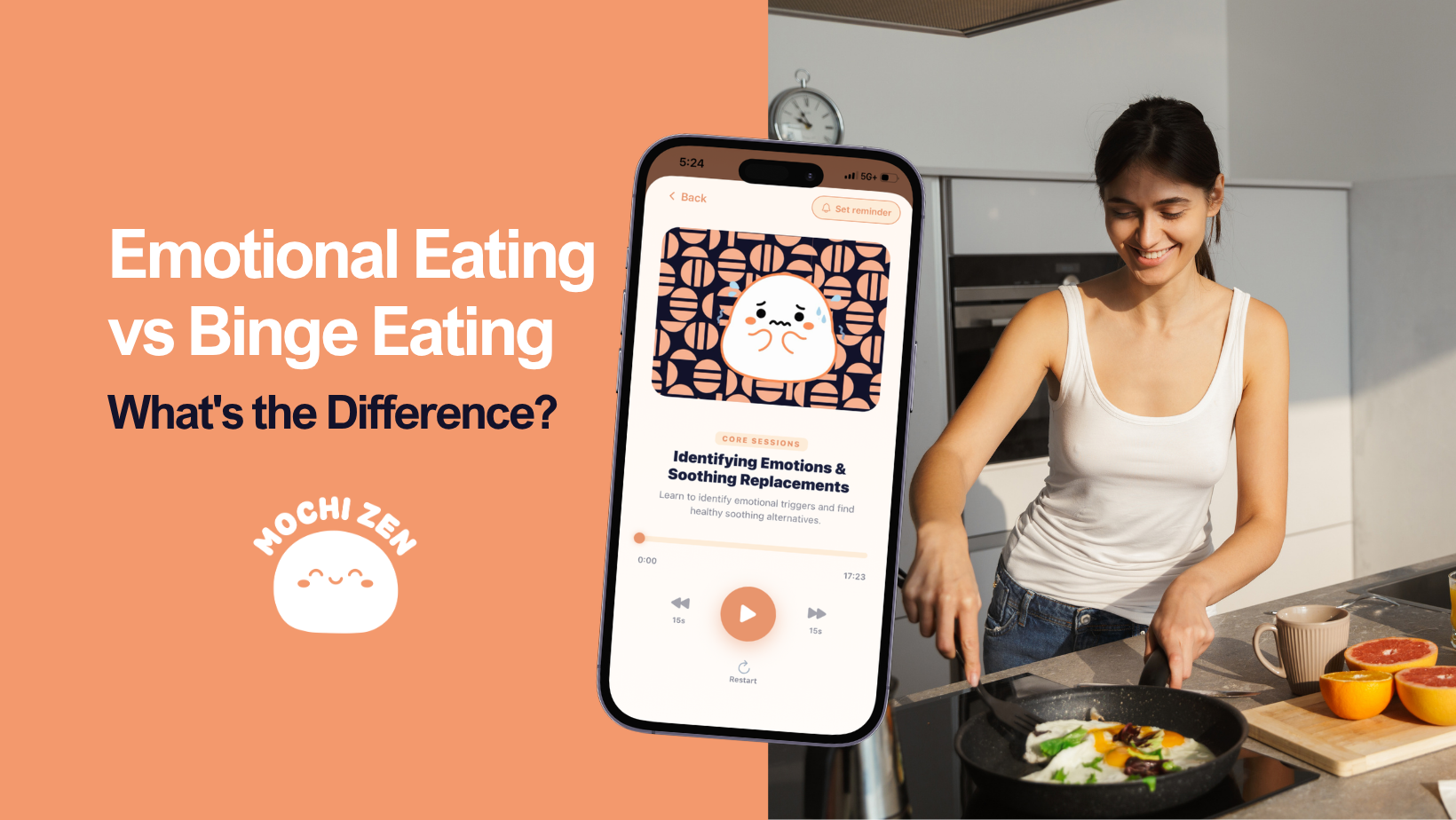
People use these two terms as if they were the same thing. They are not, and the difference is worth knowing, because what helps one pattern is not what helps the other.
Here is the short version. Emotional eating is using food to manage a feeling. Binge eating involves eating a large amount in a short period while experiencing a loss of control, and in its clinical form it is a diagnosable disorder with specific criteria. Emotional eating is extremely common and largely a learned coping habit. Binge Eating Disorder is a mental health condition that deserves professional care.
They can overlap. Plenty of people experience both. But if you have been trying to solve one with tools built for the other, that alone might explain why nothing has worked.
One thing before we go further: nothing on this page is a diagnosis, and no article can give you one. If what you read here sounds like you and it concerns you, that is worth taking to a qualified professional rather than to a search engine.
Want food to stop being the thing you manage feelings with? Try Mochi Zen free for 7 days →
In this article
- What emotional eating looks like
- What binge eating looks like
- The four differences that actually matter
- Where they overlap
- What helps each one
- The one thing they share underneath
- Frequently asked questions
What Emotional Eating Looks Like
Emotional eating is reaching for food to change how you feel rather than because your body needs fuel.
It usually has a recognizable shape. There is a trigger, often stress, boredom, loneliness, or the particular flatness of the end of a long day. There is a specific kind of food, and it is almost never celery. There is a window when it tends to happen, and for most people that window is the evening. And there is a genuine, if brief, sense of relief afterward, which is exactly why the pattern persists.
It shows up in two quite different registers, and this is where people get confused about themselves.
Sometimes it is completely ordinary: a bit more than you meant to have, most evenings, for years. Many people who do this every single day would never say they have a problem with food. They would say they like snacks at night.
But it can also be intense. A pressure that builds through the afternoon. Anxiety climbing with nowhere to put it. The thought of one specific food getting louder and louder until it crowds out whatever else you were doing, and nothing else will substitute, because the point was never the calories. It was the soothing. That experience can feel every bit as urgent and consuming as a binge, and people who live it often assume that is what they are having.
So it is worth saying clearly: intensity is not what separates these two. Emotional eating can be loud. What tends to distinguish it is that when you get to the food, you are still the one deciding, and afterward the feeling you were managing has actually eased, at least for a while. We come back to the more reliable dividing line below.
If that is the pattern you recognize, our full guide to how to stop emotional eating goes into what to do about it, and why the evening specifically is when it hits hardest.
What Binge Eating Looks Like
Binge eating is a different experience, and people who have lived both usually describe the difference immediately.
The defining feature is loss of control. Not "I ate more than I meant to," but a sense of not being able to stop once it starts, sometimes accompanied by a feeling of watching yourself from a distance. The amount is typically much larger than most people would eat in a similar period, and it happens in a specific time window rather than as grazing.
Other features commonly reported: eating much faster than usual, eating past the point of physical discomfort, eating alone specifically because of embarrassment about the amount, and intense shame, disgust, or guilt afterward. Notably, a binge does not always require an emotional trigger. It can happen when nothing in particular has gone wrong, which is one thing that distinguishes it.
When these episodes recur regularly over time and cause significant distress, that pattern may meet the criteria for Binge Eating Disorder, which is the most common eating disorder in the United States. It is a recognized clinical diagnosis and it responds to treatment. It is also frequently missed, partly because people assume eating disorders only look like restriction.
If this section describes your experience, please talk to a doctor or a licensed mental health professional. The National Alliance for Eating Disorder helpline can connect you with clinicians who treat this. That is a genuinely good outcome, not a scary one, because BED is treatable and the treatment works.
The Four Differences That Actually Matter
1. Control. Emotional eating usually feels like a choice you regret. Binge eating usually feels like something happening to you. This is the single most useful distinguishing question.
2. Amount and speed. Emotional eating varies. It can be a handful of something or a genuinely large amount, but it usually stops somewhere short of physical discomfort. Binge episodes tend to involve a large amount, quickly, and continue past the point of comfort.
3. Trigger. Emotional eating almost always traces back to a feeling, even when the buildup is gradual enough that you only spot it in hindsight. Binge episodes may have no emotional trigger at all, and can be set off by restriction earlier in the day rather than by feeling.
4. What follows. After emotional eating, the feeling you were managing has usually eased, with some regret alongside it. Binge episodes are typically followed by intense shame and distress rather than relief, and often by secrecy.
Tired of thinking about food all day? See what quiets it →
Where They Overlap
In practice these are not two sealed boxes. Emotional eating and binge eating sit on a continuum, and one can move toward the other.
The most common route runs through restriction. Someone starts a strict diet, restricts hard for several days, and eventually a rule breaks. What follows is not proportional to the hunger, because at that point biology, deprivation, and the all-or-nothing structure of the plan are all pushing in the same direction. Repeat that cycle enough times and what began as ordinary comfort eating can develop into episodes with a genuine loss-of-control quality.
This is one of the reasons the diet cycle is worth understanding on its own terms, which we cover in why diets don't work.
What Helps Each One
For emotional eating, the work is about what food is doing for you and finding another way to meet that need. Identifying triggers helps. Building a pause between impulse and action helps. But the durable change comes from addressing why food became your regulation strategy at all, which is usually a much older question than the habit itself.
For binge eating, professional treatment should be the foundation. Cognitive behavioral therapy has the strongest evidence base for BED, and there are clinicians who specialize in it. Complementary approaches, including hypnotherapy, can sit alongside that treatment as support. They should not replace it, and any practitioner who tells you otherwise is one to walk away from.
For both, one thing consistently makes things worse: more restriction. Responding to either pattern with a stricter plan reliably intensifies it.
The One Thing They Share Underneath
However different the surface, both patterns tend to share a root: food learned to do a job that something else should have been doing.
For most people that learning happened early. Food was how care was expressed in the house. Food was the reliable comfort when a bad day needed softening. Food was celebration, apology, and company. A child made a completely reasonable association, and the association is still running decades later, underneath everything you consciously know about nutrition.
That is the layer conscious effort cannot reach, which is why people who know everything about food still find themselves standing at the fridge at ten at night. The knowledge is in one part of the mind. The pattern is running in another.
Mochi Zen was created by Paola Mendez, a certified RTT hypnotherapist trained in the method developed by Marisa Peer, to work on that layer daily rather than in occasional appointments. The app combines RTT-based hypnotherapy sessions with food and weight tracking, so the pattern underneath and the practical side live in the same place.
For emotional eating, that is often the whole answer. For binge eating, it belongs alongside professional treatment rather than instead of it, and we would rather say that plainly than sell you something.
Ready for evenings that don't end at the fridge? Start your free 7-day trial →
If one-to-one work is what you need, Paola sees clients through her private practice at Pao Hypnosis, in person in Miami and remotely.
Frequently Asked Questions
What is the difference between emotional eating and binge eating?
Emotional eating means using food to manage a feeling, and it usually feels like a choice you later regret. Binge eating involves consuming a large amount in a short period with a genuine loss of control, and usually feels like something happening to you. Emotional eating is a common coping habit. Binge Eating Disorder is a recognized clinical diagnosis.
How do I know which one I have?
The most useful question is about control, not intensity. Emotional eating can feel urgent and consuming, with pressure building for hours beforehand, and still be emotional eating. If you could have stopped but chose not to, that points toward emotional eating. If stopping did not feel available to you once it started, that points toward binge eating. Only a qualified professional can actually diagnose, and this distinction is worth taking to one.
Is binge eating disorder a real diagnosis?
Yes. Binge Eating Disorder is a recognized eating disorder and the most common one in the United States. It is treatable, and it responds well to professional care, particularly cognitive behavioral therapy.
Can emotional eating turn into binge eating?
These patterns sit on a continuum and one can move toward the other, most often through repeated cycles of restriction followed by rebound. Responding to either pattern with a stricter diet tends to intensify it.
Can hypnotherapy help with binge eating?
Hypnotherapy can be a useful complement to professional treatment for binge eating by addressing the subconscious associations underneath the pattern. It should sit alongside clinical care rather than replace it. For emotional eating, which is a learned coping habit rather than a clinical disorder, hypnotherapy addresses the root more directly.
Why do I eat when I'm not hungry?
Because at some point food became the tool for something other than hunger, usually comfort, reward, or relief. That association is typically formed early and continues running below conscious awareness, which is why knowing about nutrition does not stop it.
Does willpower help with either of these?
Not durably. Willpower is a conscious resource and both patterns are driven by subconscious associations, so willpower is being applied to the wrong layer. It also depletes, which is why these patterns intensify in the evening when the day has already drained it.
Where can I get help for an eating disorder?
Start with your doctor or a licensed mental health professional. The National Alliance for Eating Disorder helpline can help you find clinicians who treat eating disorders and talk you through options.
About the Author
Paola Mendez is a Certified RTT (Rapid Transformational Therapy) Hypnotherapist trained in the method developed by Marisa Peer, and the founder and creator of Mochi Zen. She sees clients in her private practice in Miami and remotely.
This article is for informational purposes and is not medical advice or a diagnosis. Individual results vary. If you think you may have an eating disorder, please speak with a doctor or licensed mental health professional. The National Alliance for Eating Disorder helpline can help you find support.