Yes, hypnotherapy can help with weight loss, but as an add-on to a behavioral plan rather than a stand-alone fix. In the most-cited meta-reanalysis (Kirsch, 1996), people who added hypnosis to cognitive-behavioral weight treatment lost 14.88 lbs versus 6.03 lbs at the final assessment, and the gap grew after treatment ended. Critics who reanalysed the same studies found a smaller effect, so the honest summary is "a real benefit, of debated size."
If you are skeptical, that is fair. "Hypnosis for weight loss" sounds like a late-night infomercial. I'm Paola Mendez, a certified RTT (Rapid Transformational Therapy) hypnotherapist trained by Marisa Peer and the founder of Mochi Zen, so I have a professional stake in this question. That is exactly why this page shows the critics' numbers alongside the favourable ones.
Want to see whether the subconscious side of eating is your missing piece? Mochi Zen is free for 7 days.
Find Out What's Driving Your Cravings →What's in this article
The Short Answer
In one paragraph
Hypnotherapy is not a diet and does not burn calories. What the research tests is adding hypnosis to a normal behavioral weight program. Pooled across studies, that addition produced more weight loss than the program alone, and the advantage was larger at the last follow-up than at the end of treatment. The size of that advantage is debated. It works best for people whose eating is driven by emotion, habit and cravings rather than a lack of nutrition knowledge.
What Did the Research Actually Find?
The story starts in 1995, when Irving Kirsch, Guy Montgomery and Guido Sapirstein published a meta-analysis of 18 studies in the Journal of Consulting and Clinical Psychology. They compared cognitive-behavioral therapy (CBT) alone with CBT plus hypnosis across several problems, and found the hypnosis groups did better than roughly 70% of the CBT-only groups. Weight loss showed one of the largest effects.
That weight-loss figure contained computational errors, so in 1996 Kirsch ran a third meta-analysis, obtaining extra data from study authors and correcting the mistakes. That 1996 reanalysis is the paper to quote:
- Averaged across post-treatment and follow-up: 6.00 lbs lost without hypnosis vs 11.83 lbs with it (effect size 0.66).
- At the last assessment period: 6.03 lbs vs 14.88 lbs (effect size 0.98).
- The benefit of hypnosis increased over time (correlation r = .74).
That last point is the unusual one. Most weight interventions peak at the end of treatment and slowly reverse. In these studies the hypnosis groups kept pulling ahead after treatment stopped, which is what you would expect if something underneath the behavior had shifted rather than just the behavior itself.
Research is one thing; here's what it looked like for one member: Sharonda's story of quieting food noise.
What Do the Critics Say?
Any honest page on this topic has to include the other reanalysis. In the same 1996 journal issue, David Allison and Myles Faith re-examined the six weight-loss studies from the 1995 paper. After correcting errors, they found a much smaller average effect (0.26), and when one questionable study was removed the effect (0.21) was no longer statistically significant. Their conclusion: adding hypnosis to CBT gives "at most, a small enhancement."
So two careful research groups looked at overlapping data and landed in different places. Kirsch had additional data from the original authors; Allison and Faith were stricter about which studies to include. Neither found that hypnosis hurts, and both were testing hypnosis as an add-on, not a replacement. What is fair to say in 2026:
- The direction of the evidence favours adding hypnosis.
- The size of the benefit is genuinely debated, and the trials are old and small.
- Anyone promising guaranteed or dramatic results from hypnosis alone is overselling it.
What Does NCCIH Say About Hypnosis?
The National Center for Complementary and Integrative Health (NCCIH), part of the NIH, keeps a plain-language overview of hypnosis. It discusses research on irritable bowel syndrome, pain, anxiety, menopausal hot flashes, headaches and smoking cessation, and describes hypnosis as generally safe when done by a trained professional. It does not currently make any statement about weight loss either way, and the page was last updated in 2020.
In other words, NCCIH is not the source of the weight-loss evidence. The Kirsch and Allison reanalyses above are, and you can read both abstracts yourself on PubMed. If you see a site claiming NCCIH "endorses" hypnosis for weight loss, treat the rest of that page with caution too.
Why Would Hypnosis Help With Weight?
Most people who struggle with weight are not missing information. They know what a vegetable is. What they cannot explain is why they reach for food at 11pm when they are not hungry, or why they lose the same ten pounds and regain it every time.
That behavior is largely automatic. If food became comfort during a hard childhood, your brain learned when things feel hard, eat. If food was a reward, it learned food means love and safety. These associations fire faster than conscious decision-making, which is why willpower can resist them for a while but rarely rewrites them.
Hypnosis is a state of focused attention in which people become more responsive to suggestion; brain-imaging work (Jiang et al., 2017) shows reduced activity in regions tied to self-monitoring during hypnosis. The theory behind using it for eating is that it gives new associations a better chance to take hold than conscious effort alone. That also fits the Kirsch finding that the benefit grew after treatment: changed associations keep working without ongoing effort.
Is All Hypnosis the Same?
No, and this is where many people's "I tried hypnosis and it didn't work" comes from. Stage hypnosis is entertainment. A generic "you don't like sugar" recording is suggestion without any work on why you eat. The studies above used structured clinical hypnosis inside a behavioral program.
RTT, developed by Marisa Peer, adds a step that pure suggestion skips: it first looks for where a pattern came from, then reframes it. In a one-to-one session, that means a 90-minute session plus a personalised recording you listen to daily for 21 days. The 21 days is RTT's reinforcement protocol, not a claim about how long habits take to form; research on habit formation (Lally et al., 2010) found a median of 66 days. For a deeper look at the method itself, see hypnotherapy for weight loss: the RTT approach.
Daily RTT-based sessions for emotional eating and cravings, plus a food log that asks why, not just what.
Stop Fighting Food: Try Mochi Zen Free →What a Licensed Psychologist Says About Mochi Zen
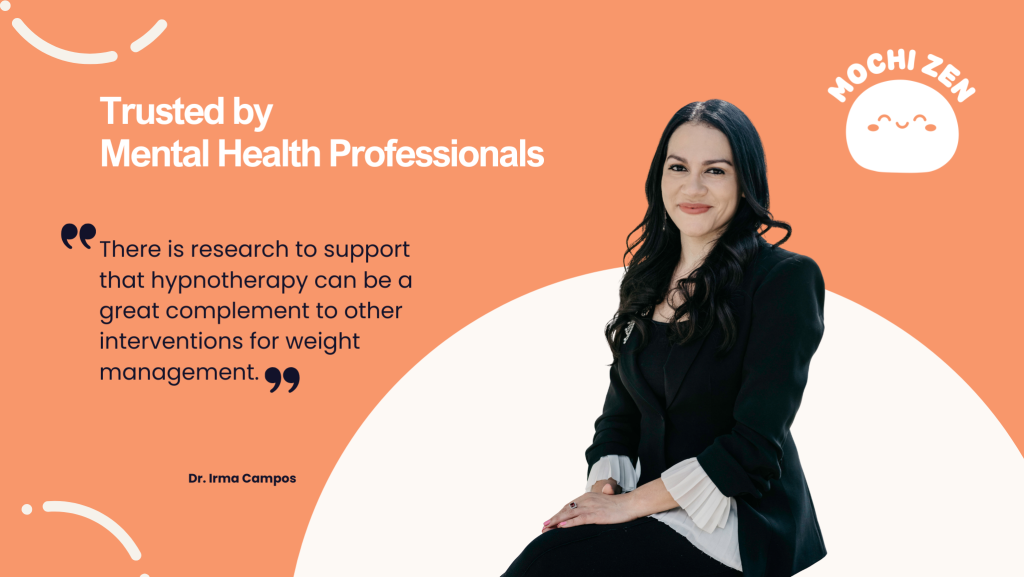
Dr. Irma Campos, Psychologist at Interface Consulting and Psychological Services, reviewed Mochi Zen and gave this assessment:
"As a psychologist, I believe Mochi Zen offers convenient, supportive, and effective hypnotherapy interventions to improve one's relationship with food. In fact, there is research to support that hypnotherapy can be a great complement to other interventions for weight management.
Mochi Zen's guided yet soothing hypnotherapy sessions can help explore patterns that exist between you and food. The food tracker offers great options (including gluten free and other common alternatives) to select from to easily record macros. The journal section was a helpful add-on, offering an opportunity to see how mood, hypnotherapy, and eating patterns can be connected. This can help you generate more insight and awareness to make behavioral changes. Overall, using the app is seamless, and it is rewarding to see changes over time."
Dr. Irma Campos, Psychologist
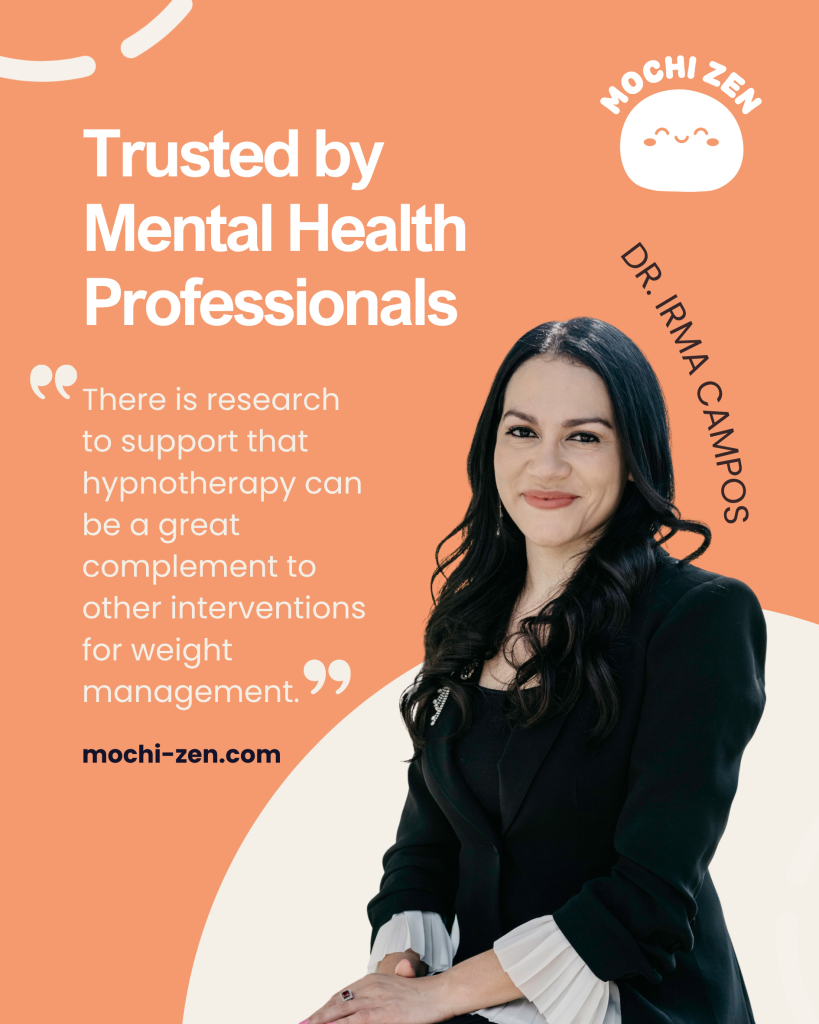
Notice her framing matches the research: hypnotherapy as a complement to other weight-management work. That is how Mochi Zen is built. Alongside the RTT-based sessions it has an AI photo meal scanner, typed-sentence logging, a USDA food search, exercise and water tracking, a macros calculator, a weight tracker, and a journal that links mood to eating. If you already work with a doctor, dietitian or therapist, it is meant to support that work, not replace it.
Who Does Hypnotherapy for Weight Loss Work For?
It tends to fit people whose weight struggle has a strong psychological component. If any of these sound familiar, that's you:
- "I know what I'm supposed to eat. I just can't stick to it."
- "I eat when I'm stressed, bored, anxious or lonely, not when I'm hungry."
- "I've lost this weight before. I always gain it back."
- "I self-sabotage every time I start making progress."
That is the pattern described in emotional eating vs binge eating, and it is where subconscious-level work has the most to offer.
It is not a fit as a replacement for medical care. If a hormonal, metabolic or other medical issue may be driving weight gain, talk to a doctor. If you are weighing medication, our comparison of Ozempic vs hypnotherapy covers what each one does. And if you have an eating disorder, work with a clinician first.
How to Try Hypnotherapy for Weight Loss
There are two routes, one self-directed and one personalised.
Mochi Zen (at home). RTT-based audio sessions I created for weight, emotional eating and food noise, which you listen to daily, ideally as you fall asleep, alongside the app's food logging. It runs on iPhone, Android and the web, with a 7-day free trial. It is the lowest-commitment way to find out whether this layer is what has been missing.
One-to-one RTT sessions. For people with a long history with food, or who want the work built around their own story, I see private clients in Miami and remotely through Pao Hypnosis. A session goes directly into your individual history and includes a recording made for you.
Whichever you choose, keep a normal, sensible eating and movement plan running alongside it. That is what every study above tested, and it is the version of hypnotherapy for weight loss the evidence actually supports.
The research tested hypnosis as an add-on. Mochi Zen puts the add-on and the food log in one place.
Try Mochi Zen Free for 7 Days →Frequently Asked Questions
Does hypnosis for weight loss really work?
It helps as an add-on to a behavioral plan. Kirsch's 1996 meta-reanalysis found people adding hypnosis lost 14.88 lbs versus 6.03 lbs at final assessment. A competing reanalysis by Allison and Faith found a smaller benefit. Evidence favours hypnosis, but the size of the effect is debated.
How does hypnotherapy for weight loss work?
Hypnosis is a focused state in which people respond more readily to suggestion. For eating, it targets the automatic associations behind cravings and emotional eating, such as food meaning comfort. RTT also looks for where a pattern started before reframing it, so the change does not rely on willpower.
How many hypnotherapy sessions do you need to lose weight?
In one-to-one RTT, many clients work through a weight or eating pattern in one to three 90-minute sessions, each followed by 21 days of listening to a personal recording. With an app, you listen daily. Either way, results depend on the person and are not guaranteed.
Is weight loss from hypnotherapy permanent?
Nothing guarantees permanence, but the research pattern is encouraging: in Kirsch's reanalysis the advantage of the hypnosis groups grew after treatment ended rather than fading. Keeping a sensible eating and movement plan alongside it matters, and individual results vary.
Can I do hypnotherapy for weight loss at home?
Yes. Audio programs let you listen daily at home. Mochi Zen offers RTT-based sessions for weight, emotional eating and food noise on iPhone, Android and the web with a 7-day free trial. For personalised work, one-to-one RTT sessions are available through Pao Hypnosis in Miami and remotely.
Does hypnosis help with emotional eating?
Emotional eating is one of the best fits for hypnosis, because it is driven by learned associations between feelings and food rather than a lack of knowledge. Hypnotherapy works on that association directly, so a stressful moment stops leading automatically to the fridge. Severe binge eating should also involve a clinician.
What does NCCIH say about hypnosis for weight loss?
Nothing specific. The NCCIH hypnosis overview, last updated in 2020, covers IBS, pain, anxiety, hot flashes, headaches and smoking, and calls hypnosis generally safe with a trained professional. The weight-loss evidence comes from the Kirsch and Allison meta-reanalyses published in 1996.
Is hypnotherapy for weight loss safe?
For most people, yes. You stay aware throughout, and NCCIH describes hypnosis as generally safe when done by a trained professional. It is not a substitute for medical care. If you have a serious mental health condition, an eating disorder or a medical cause of weight gain, speak with a clinician first.
Disclaimer: This post is for informational purposes only and is not a substitute for professional medical or mental health care. Results vary. If your struggle with weight, overeating, or disordered eating is severe or persistent, or you suspect a medical cause, please consult a qualified healthcare provider.