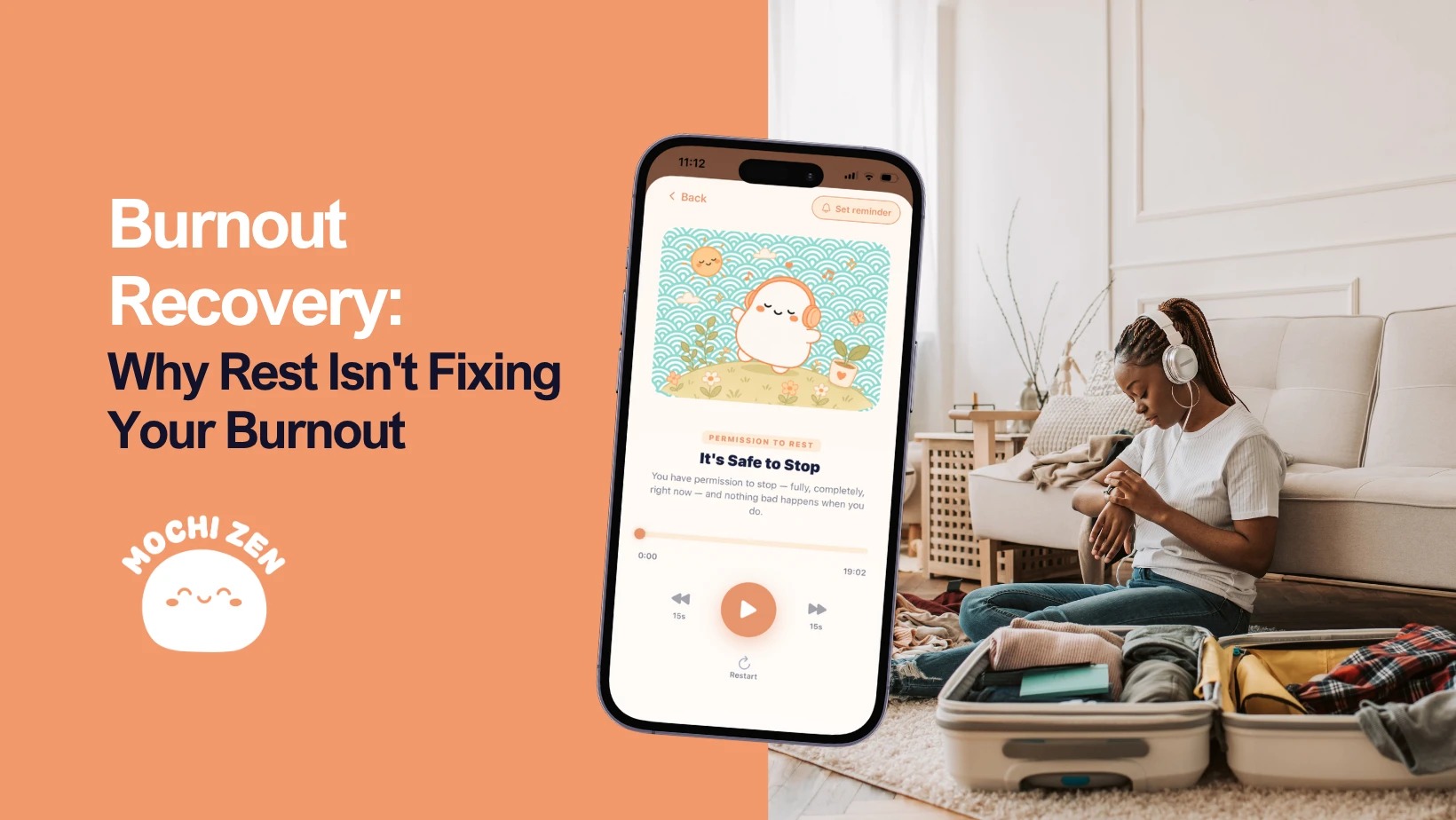
It's the Sunday night after your vacation. Your suitcase is still unpacked, there's sand in a shoe somewhere, and you're lying in bed with your mind going over Monday's inbox. You had a whole week off. You slept in. Maybe you finished a book. And somehow you feel exactly as tired as the day you left.
Here's the reason why: rest isn't fixing your burnout because part of you doesn't believe you're allowed to rest. When a subconscious rule says rest must be earned, or that your worth is your output, your body can be on a beach while your mind and nervous system stay on the clock. Real burnout recovery has two layers: practical changes to how you work and rest, and a change to the subconscious rule that turns rest into guilt.
I'm Paola Mendez, certified RTT (Rapid Transformational Therapy) hypnotherapist, trained in the method developed by Marisa Peer, and founder of Mochi Zen. I'll be honest from the start: if your job is genuinely impossible, no audio session will fix that. Workload matters. So do money, caregiving and health. This post is about what's left when you've already tried resting and it didn't work.
Give Yourself Permission to Rest. Try Mochi Zen Free for 7 Days →
What's in This Article
- What is burnout, really?
- Why am I still tired after vacation?
- Why can't I rest without feeling guilty?
- Signs your burnout is a subconscious program, not just a workload
- How do you recover from burnout in 2026, one step at a time?
- What does changing the program actually look like?
- When should you see a professional?
- Frequently asked questions
What Is Burnout, Really?
The World Health Organization describes burnout as a syndrome resulting from chronic workplace stress that has not been successfully managed. It has three dimensions: exhaustion, growing mental distance or cynicism about your job, and reduced professional efficacy. The 11th revision of the International Classification of Diseases lists burnout as an occupational phenomenon, not a medical condition (WHO, 2019).
That framing puts the cause where it often starts: the work. The work explains why burnout begins. The subconscious program explains why it doesn't stop when the work does.
Why Am I Still Tired After Vacation?
First, you're not imagining it. A meta-analysis by de Bloom and colleagues (2009) in the Journal of Occupational Health pooled seven vacation studies and found that time off gave a small boost to health and well-being, and that the boost faded soon after people went back to work. So if your post-vacation glow lasted about as long as your tan, that's the average, not a personal failure.
Second, being away from work is not the same as recovering from it. Researchers Sabine Sonnentag and Charlotte Fritz identified four recovery experiences, and the first one is psychological detachment: not just being off the clock, but not thinking about work at all (Sonnentag & Fritz, 2007). Here's where the program comes in. You can't detach from something your subconscious believes you're not allowed to put down.
Why Can't I Rest Without Feeling Guilty?
Because somewhere along the way you learned a rule, and it made sense at the time. Maybe attention came most reliably when you achieved. Maybe you were the responsible one. Maybe resting in your house looked like laziness. Your mind wrote those lessons down as fact: rest must be earned. My worth is what I produce.
Your subconscious doesn't check whether a rule still fits your life. So the moment you lie on the couch, guilt shows up with a clipboard: you should be doing something. That guilt is a form of vigilance, and vigilance is work. Your body clocks out. Your mind stays on shift.
That's why the line on our program page lands for so many people: "You've taken the vacation. You came back just as tired." The rest was real. It just never reached the part of you that was still working.
Signs Your Burnout Is a Subconscious Program, Not Just a Workload
- You feel guilty within minutes of stopping, even when everything is done.
- Rest only feels allowed once you've earned it, and the bar keeps moving higher.
- Vacations help for a few days, then it's like you never left.
- Unstructured time makes you anxious, not relaxed.
- You feel fine when you're useful to someone and flat when you're not.
- You've changed jobs before, and the burnout followed you.
A simple test: if your exhaustion is reduced when the workload drops, it's mostly workload. If it follows you from job to job and vacation to vacation, there's probably a rule underneath. Most people have some of both.
How Do You Recover From Burnout in 2026, One Step at a Time?
Start with the practical layer. It lowers the load so the deeper work has room to happen.
- Name the load: Write down everything on your plate. If it's more than one person can do, that's a conversation with your manager, your doctor or your bank account. No mindset work changes math.
- Protect sleep first: Exhaustion and poor sleep feed each other. If your mind races at night, start with why you can't sleep.
- Build a shutdown ritual: At the end of each workday, close your tabs, write tomorrow's top three tasks and say "done for today." It's a signal to your mind that detaching is allowed.
- Take small rests, not just big ones: Since vacation benefits fade, a daily walk without your phone gives you more chances to practice resting than one trip a year.
- Cut decisions where you can: Burnout drains the same tank you use to choose. Repeat meals, simplify evenings. I explain the link in decision fatigue and the 5 PM crash.
- Catch the guilt and name the rule: When guilt shows up during rest, ask, "What rule am I breaking right now?" Write it down in one sentence. Seeing it on paper loosens its grip.
- Work on the rule itself: This is the root-cause layer, and it's where hypnotherapy comes in.
What Does Changing the Program Actually Look Like?
In RTT, we use a relaxed, focused state to find where a belief came from and update it, like changing an old phone setting you forgot you'd chosen. You stay aware and in control the whole time.
The Mochi Zen Burnout program has 13 guided sessions in four arcs. It starts with Permission to Rest, with sessions like "It's Safe to Stop," "Rest Is Productive" and "Your Worth Is Not Your Output." Then it goes to the roots with "Releasing the Inner Taskmaster" and "You Don't Have to Earn Love," then moves into restoration, boundaries and a new relationship with work. You listen to one session daily for a week, and a new one unlocks each week. Guided journaling and habit tracking are built in. If you want to know whether hypnosis helps burnout at all, I wrote an honest look at the research.
Burnout rarely travels alone. If you're also struggling with motivation to exercise or stress and weight, the same rule is often running underneath.
Retire the Rule That Burned You Out. Start Your Free Week →
When Should You See a Professional?
If your exhaustion persists for weeks despite rest, or it comes with hopelessness, losing interest in things you used to love, or big changes in sleep or appetite, talk to a doctor or a licensed mental health professional. Burnout can overlap with depression, and fatigue can have medical causes too. If you're having thoughts of not wanting to be here, call or text 988 to reach the 988 Suicide & Crisis Lifeline in the US, any time.
Frequently Asked Questions
How do you recover from burnout?
Burnout recovery works on two layers. First, reduce the load: address workload, protect sleep and build daily rest. Second, address the subconscious rule that makes rest feel unearned. Individual results vary.
Why am I still tired after vacation?
A 2009 meta-analysis found vacation benefits are small and fade soon after returning to work. Recovery also depends on psychological detachment, not just time off. If guilt keeps your mind working while your body rests, the vacation can't fully restore you.
Why can't I rest without feeling guilty?
Guilt during rest usually comes from a learned rule, such as "rest must be earned" or "my worth is my output." The subconscious enforces the rule even when it no longer fits your life, keeping you on alert while you try to relax.
Why won't my burnout go away?
Burnout that persists after time off often has two causes: a workload that hasn't changed, and a belief that rest isn't allowed. If the exhaustion follows you across jobs and vacations, the belief is likely part of it.
Can hypnosis help with burnout recovery?
Hypnotherapy works on the subconscious beliefs that make rest feel unsafe or unearned. It's a wellness tool, not medical treatment, and it can't fix an unsustainable job.
How long does burnout recovery take?
There's no standard timeline. It depends on how long you've been running on empty, whether your workload changes and what's driving the exhaustion.
Disclaimer: This post is for informational purposes only and is not medical or mental health advice. Mochi Zen is a wellness tool and does not replace professional care. Ongoing exhaustion can have medical causes; please consult a qualified healthcare provider. If you are in crisis in the US, call or text 988. Individual results vary.