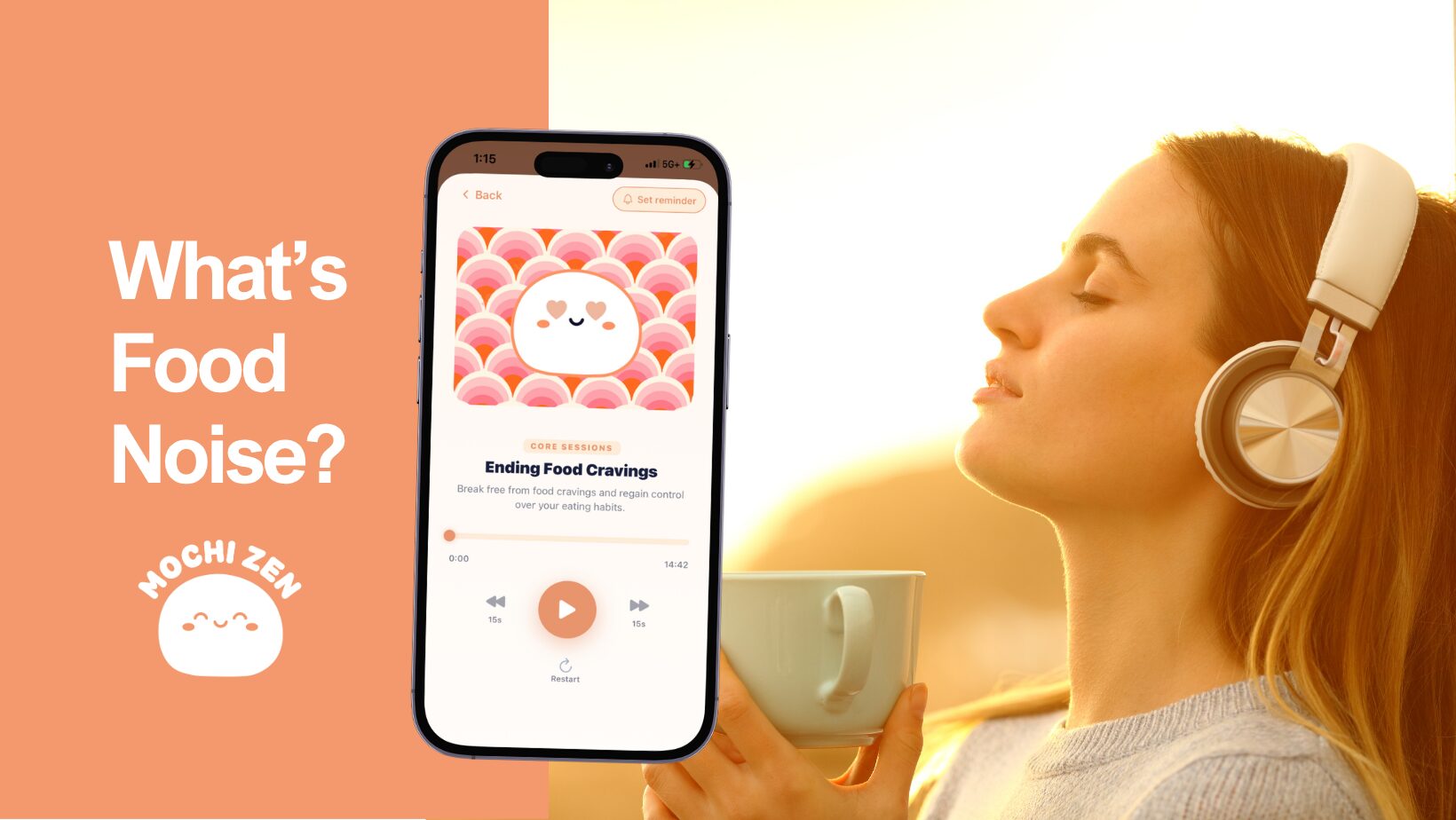
When Ozempic became mainstream, patients started reporting something unexpected, something that had nothing to do with the scale.
They called it the silence.
For the first time, they weren't thinking about food. Not planning their next meal while eating the current one. Not replaying what they'd had for breakfast. Not mentally negotiating whether they could afford the bread at dinner. The constant, low-level mental chatter about food had just... stopped. And the experience was so disorienting, so revelatory, that it gave the wellness world a new term: food noise.
If you recognized yourself in that description, this post is for you.
Because here's what the Ozempic conversation revealed: food noise was never about hunger. And it was never going to respond to willpower, tracking, or trying harder. It's a subconscious program, and the only way to quiet it is to go where it actually lives.
Quiet the Noise for Good: Try Mochi Zen Free
What Is Food Noise, Exactly?
Food noise is the constant, involuntary mental chatter about food that runs through your day whether or not you're actually hungry.
It sounds like:
- "What am I going to have for lunch?"
- "I probably shouldn't have eaten that."
- "I want something but I don't know what."
- "Just one more. No, I'm done. Maybe one more."
- "I've been good today. I can have this. Wait, should I?"
For many people, this noise runs so constantly that it feels like a personality trait. I'm just someone who loves food. I'm just someone who thinks about eating all the time. They assume this is who they are, not a pattern they developed.
But food noise isn't a personality. It's a loop. A mental program running on repeat. And like any program, it can't be stopped by simply deciding to stop it.
The Ozempic experience made this starkly visible. Patients who described "the silence" weren't suddenly people who hated food. They still enjoyed eating. They just weren't consumed by it anymore. The obsessive mental chatter (the negotiating, the calculating, the constant pull) was gone. And in its absence, they realized for the first time how much cognitive bandwidth food noise had been taking up.
If you've never experienced that silence, it might be hard to imagine. If you have, even briefly, you know exactly how different it feels.
It's Not a Willpower Problem
Here's the first and most important reframe: food noise is not evidence that you lack discipline.
Willpower is a conscious-mind tool. It lives in the prefrontal cortex, the rational, decision-making part of your brain. And yes, it can override food thoughts in the short term. You can white-knuckle your way through a meal. You can choose the salad. You can say no to the second helping.
But here's the problem: willpower is finite. It depletes through the day, through stress, through decision fatigue. Researchers have shown that self-control is a limited resource: the more you use it, the harder each subsequent use becomes.
The subconscious mind, on the other hand, never depletes. It runs 24 hours a day, processing and reinforcing its programs regardless of how tired or stressed or distracted you are.
So what happens when you're using willpower to fight a subconscious program? You might win at 9am. By 9pm, after a full day of decisions, stress, and override, the subconscious wins. Not because you're weak. Because willpower was always playing a game it couldn't win.
"You can't think your way out of a pattern that lives below thought. That's not failure. That's just how the mind works."
The research backs this up. A landmark study published in the Journal of Consulting and Clinical Psychology (Kirsch, Montgomery & Sapirstein, 1995) found that patients who used hypnotherapy alongside behavioral methods lost more than twice as much weight as those using behavioral methods alone, and maintained that loss at a two-year follow-up. Behavioral methods engage the conscious mind. Hypnotherapy works in the subconscious. That's why the combination outperforms either one alone.
Where Food Noise Actually Comes From
RTT (Rapid Transformational Therapy), developed by world-renowned therapist Marisa Peer and the methodology behind every Mochi Zen session, offers a precise framework for understanding where food noise originates.
It starts with an association. Usually formed long ago.
Think about how many of us learned to relate to food growing up:
- Food was used to celebrate: birthdays, achievements, good days.
- Food was used to comfort, when you were sick, sad, or scared.
- Food was the one reliable thing that felt good when everything else felt uncertain.
- "Clean your plate" was a rule, not a suggestion.
- Snacks were rewards. Dessert was earned. Eating was love.
Your subconscious filed all of this. It built rules: food equals safety. Food equals love. Eating means I'm okay. I'm not settled until I've eaten.
Once those rules are in place, the subconscious enforces them, constantly. Not because you're broken. Because the mind's number-one job is to keep running the programs that made you feel safe. It does this automatically, below the level of conscious thought.
That's food noise. It's the subconscious doing its job: running a program that no longer serves you, but that it hasn't received any signal to update.
This is also why food noise tends to spike under stress, loneliness, boredom, and anxiety. Those are the precise emotional states the subconscious associated with food as relief. The signal goes out: these conditions = time to eat. You don't decide to think about food. The program fires automatically.
Why Diets Make Food Noise Worse
Here's the painful irony of most diet approaches: restriction is one of the fastest ways to amplify food noise.
When the conscious mind declares certain foods off-limits, the subconscious focuses on them more intensely, a well-documented psychological phenomenon sometimes called the "forbidden fruit effect" or, in clinical literature, ironic process theory. The harder you try to suppress a thought, the more persistently it intrudes.
Tell yourself you can't have pasta, and the subconscious hears: pasta is important. Pasta is scarce. Pasta is something to think about.
This is why chronic dieters often report more food noise than people who have never dieted at all. Years of restriction cycles train the brain to treat food as both a threat and a reward, and the mental chatter about food increases accordingly.
The solution, then, isn't more restriction. It's not a stricter plan or a better tracking app. It's updating the underlying program so that food stops being a charged topic entirely. So that pasta is just pasta. Dinner is just dinner. And the mental negotiation simply... stops.
What Actually Quiets Food Noise
Because food noise is a subconscious program, quieting it requires working at the subconscious level. That means approaches that only engage the conscious mind (journaling, tracking, planning, affirmations, mindfulness without the deeper component) can reduce the volume temporarily, but they don't touch the root.
What updates a subconscious program is accessing it directly. In RTT hypnotherapy, that means going into a relaxed, receptive state where the subconscious is accessible, and introducing a new story. A new belief. One that doesn't associate food with emotional need.
When that association changes at the root, the signal stops firing. The loop has nothing to run on. The noise fades, not through force, but because the underlying program was updated.
This isn't a metaphor. This is how the brain works. New neural pathways, reinforced through repetition, eventually become the dominant pattern. The old pathway (food equals comfort) gets quieter as the new one (I eat to nourish my body; I am emotionally safe without food) grows stronger.
That process takes repetition. Which is exactly what Mochi Zen is built for.
To see what this looks like in practice, read how Sharonda quieted a lifetime of food noise in three weeks, after losing and regaining 200+ pounds.
Start Your 7-Day Free Trial (No Credit Card Required)
How RTT Hypnotherapy Addresses Food Noise at the Root
RTT (Rapid Transformational Therapy, the methodology developed by Marisa Peer and built into every Mochi Zen session) works by accessing the subconscious directly and updating the beliefs that drive behavior.
In an RTT session focused on food noise, the work centers on a few key shifts:
Finding the original association
Most food noise isn't about hunger; it's about an older emotional need that got linked to eating. RTT identifies that link. Once you understand why the subconscious wired food to comfort, safety, or reward, the association loses much of its power.
Separating food from emotional need
The subconscious is updated with a new belief: I am safe. I am enough. I can meet my emotional needs without food. Food is nourishment, not medicine, not comfort, not reward. When that belief is genuinely in place, the subconscious stops sending the food-obsession signal.
Building a new identity
This is the deepest level of the work, and the most durable. When you stop identifying as "someone who struggles with food," the food noise loses its grip. You don't have to fight it. You've simply become someone it doesn't apply to.
This is the identity shift that RTT practitioners, including Mochi Zen founder Paola Mendez, see in clients: not just changed behavior, but a changed experience of being in a body around food. The chatter stops because the person it was talking to has changed.
How Mochi Zen Works on Food Noise Every Day
A single RTT session can create meaningful shifts. But the food noise that took years to develop isn't completely rewired in one listen. The subconscious learns through repetition, the same way it learned the original program in the first place.
Mochi Zen is built for daily repetition. Every session you listen to reinforces the new belief: food is neutral, you are safe, your relationship with eating is one of nourishment rather than need. Each listen makes the new neural pathway stronger, and the old one quieter.
Most people notice a change within the first week. The food thoughts are still there, but they're easier to observe and let pass rather than follow. By week three, for many users, the constant negotiation starts to feel like background static instead of foreground noise. By week six, some describe it the way those Ozempic patients did: I just stopped thinking about it so much.
Alongside the RTT audio sessions, Mochi Zen's AI-powered nutrition tracker helps you reconnect with actual hunger signals, so you can practice distinguishing physical hunger from the habitual mental chatter. The daily journal creates a space to process what comes up emotionally, so the subconscious has somewhere to put it that isn't food.
Most weight loss apps track what you eat. Mochi Zen addresses why. And for the people for whom food noise has been the real barrier (not knowledge, not a meal plan, not a calorie target) that distinction is everything.
If you want more support alongside the app (a deeper dive into the specific associations driving your food noise), a one-on-one RTT session with Paola addresses it directly and personally.
Try Mochi Zen Free for 7 Days: See What the Quiet Feels Like
Frequently Asked Questions About Food Noise
What exactly is food noise?
Food noise is the persistent, involuntary mental chatter about food (thinking about what to eat, replaying what you've already eaten, negotiating with yourself about food choices) that runs through the day independently of physical hunger. It's a subconscious pattern, not a character trait.
Is food noise the same as emotional eating?
They're related but distinct. Food noise is the mental chatter: the constant preoccupation with food as a subject. Emotional eating is the behavior of turning to food in response to emotions rather than hunger. Food noise often drives emotional eating: when your brain is constantly looping on food, reaching for food when you're stressed or bored feels natural. Addressing the subconscious root of the noise also tends to reduce emotional eating.
Can willpower reduce food noise?
Willpower can temporarily override the impulses that food noise creates, but it doesn't quiet the noise itself. Willpower is a finite, conscious-mind resource. Food noise lives in the subconscious, which operates continuously below conscious awareness. The only way to reduce food noise durably is to update the subconscious program driving it, which is what RTT hypnotherapy is designed to do.
Why did Ozempic make food noise go away for some people?
GLP-1 drugs like Ozempic and Wegovy appear to reduce food noise through a neurological mechanism, affecting dopamine signaling and reward pathways in the brain, which reduces the compulsive preoccupation with food. However, they don't address the underlying emotional or subconscious associations that created the food noise, which is why many people report that some food noise returns when dosage changes or the medication is stopped. RTT hypnotherapy works on the subconscious associations directly, creating a change that doesn't require ongoing pharmaceutical maintenance.
How long does it take for RTT hypnotherapy to quiet food noise?
Results vary by person and by the depth of the underlying associations. Many Mochi Zen users report a noticeable reduction in food noise within the first one to two weeks of daily listening. More significant and lasting shifts typically emerge over four to six weeks of consistent use. The key is daily repetition: the subconscious learns through repeated exposure to the new belief, not from a single session.
Is food noise a sign of an eating disorder?
Not necessarily. Food noise exists on a wide spectrum and is extremely common, particularly among people who have dieted repeatedly. That said, if food noise is significantly interfering with your daily functioning, relationships, or quality of life, it's worth speaking with a healthcare provider or mental health professional in addition to exploring RTT hypnotherapy. If you're looking for one-on-one support, a personal RTT session with Paola may be a good starting point.
Does Mochi Zen work if I still want to eat the foods I love?
Yes, and this is actually one of the core principles of RTT-based work. The goal isn't to make you fear food or stop enjoying it. It's to make food neutral: something you appreciate and eat with genuine pleasure, rather than something your brain loops on obsessively. Most Mochi Zen users find that as food noise quiets, they actually enjoy eating more. The difference is they're present for it rather than caught in the mental chatter around it.
What makes Mochi Zen different from a regular meditation or mindfulness app?
Mindfulness apps train the conscious mind to observe thoughts without reacting to them. That's valuable, but it doesn't update the underlying subconscious program creating those thoughts in the first place. Mochi Zen's RTT-based sessions go deeper: they're designed to access the subconscious and install new beliefs at the root, so the food-obsession signal stops firing rather than just being observed as it fires. It's the difference between managing the noise and actually quieting it.
About the Author
Paola Mendez is a certified RTT hypnotherapist trained in the methodology developed by world-renowned therapist Marisa Peer, and the founder of Mochi Zen, a weight loss app combining RTT-based hypnotherapy with AI-powered nutrition tracking, available on iOS, Android, and web. Paola spent over 10 years as a software developer before discovering RTT and making a full career transition into hypnotherapy. She also runs Pao Hypnosis, a private practice serving clients in Miami and remotely.