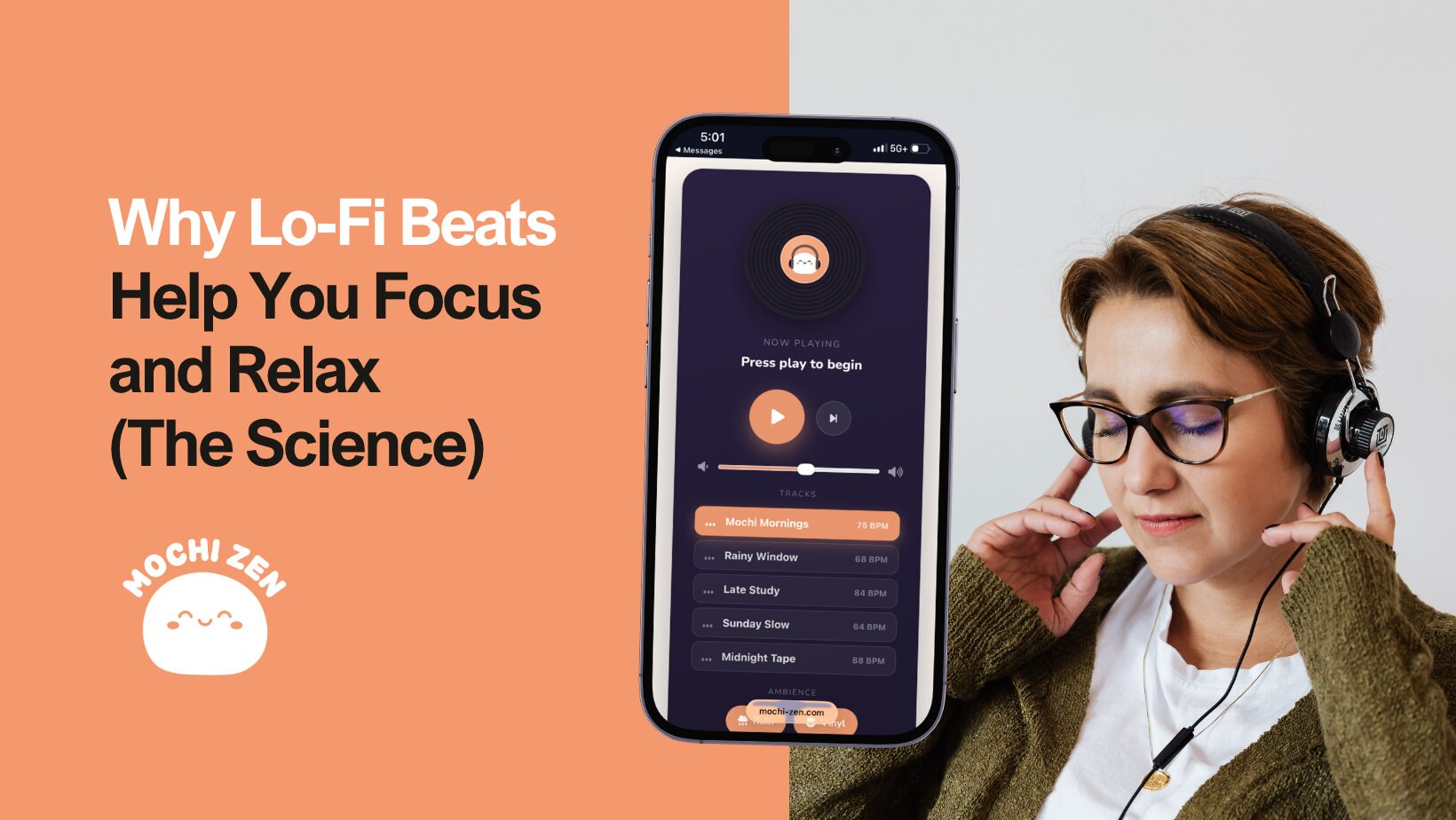
There's a reason "lo-fi beats to relax/study to" has been playing quietly in the background of millions of lives for years now. Something about those warm, slightly crackly, unhurried beats makes it easier to settle in, focus, and breathe out.
It's not just a vibe; there's real psychology behind why lo-fi works so well. Here's what's actually happening, and a free player so you can feel it while you read.
Try it while you read
Free, endless lo-fi beats generated live in your browser, no ads, no sign-up. Add rain or vinyl crackle to taste.
Open the Lo-Fi PlayerWhat makes a beat "lo-fi"?
Lo-fi is short for low-fidelity: audio that deliberately keeps its imperfections instead of polishing them out. A lo-fi track usually has a few signature ingredients: soft, jazzy chords (often seventh chords that sound warm and slightly wistful), a relaxed drum groove at around 70–90 BPM, a simple bassline, and textural "flaws" like vinyl crackle, tape hiss, and muffled, rounded-off high frequencies.
Those flaws aren't mistakes; they're the whole point. The crackle and warmth make the music feel analog, human, and cozy, like a memory rather than a performance. And crucially, that gentle imperfection keeps the music in the background, where it belongs when you're trying to focus.
Why it helps you focus
The honest scientific picture: research on "music and productivity" is genuinely mixed, and the effect depends heavily on the person, the task, and the music. But lo-fi happens to check nearly every box for the kind of music that interferes least with focused work, and can actively help.
- No lyrics. Words compete for the same language-processing resources you use to read, write, and think. Instrumental music sidesteps that conflict, which is why lyric-free genres tend to be friendlier to focused work.
- Low complexity and repetition. Lo-fi loops are simple and predictable, so your brain habituates quickly and stops paying attention to them. Music that's too surprising or emotionally intense keeps pulling your focus back.
- It masks distractions. A steady bed of sound covers the unpredictable noises (a conversation, a door, traffic) that actually break concentration. Consistent, gentle sound is easier to ignore than intermittent silence-then-noise.
- It's a ritual cue. Press play, and your brain learns the association: this sound means it's time to work. That consistency helps you drop into "focus mode" faster over time.
- It stabilizes mood. A calm, pleasant backdrop keeps you in a steady emotional state, which supports sustained attention better than boredom or agitation.
There's also a small but interesting body of research suggesting that a moderate level of ambient sound (not silence, not loud) can support certain kinds of thinking, including creative work. Lo-fi sits comfortably in that gentle middle zone.
Why it helps you relax
Focus is only half the story. A lot of people put on lo-fi not to work but to wind down, and that makes sense too.
The slow tempo naturally invites your body toward a calmer rhythm. The soft, warm chords carry a gentle, nostalgic emotional tone: present but never intense. And the looping, predictable structure gives an anxious or over-stimulated mind something steady and safe to rest on, much like the appeal of cozy games or a familiar show playing quietly in the background. It asks nothing of you. It's just there, keeping you company.
Press play and settle in
Our little browser-based lo-fi player loops endlessly, never repeats exactly, and works offline once loaded.
Open the Lo-Fi PlayerWhere the beat ends and the pattern begins
Here's the honest edge of it, the same one I put on every tool I love: lo-fi is wonderful for the moment. It can help you focus through an afternoon, soften a stressful evening, or ease you toward sleep. What it can't do is change the pattern underneath.
If you find you can't focus no matter what's playing, or the restlessness and anxiety keep returning the moment the music stops, that's a sign something deeper is running the show, usually a subconscious pattern that formed long ago. That's the layer RTT hypnotherapy is built to reach, and it's what the Mochi Zen app does. The beats soothe the surface; the sessions change the source.
So put the player on. Genuinely enjoy it. And if the restlessness underneath keeps asking for attention, that's what we're here for.
Lo-fi calms the moment. Mochi Zen's RTT hypnotherapy calms the pattern: anxiety, sleep, and emotional eating, at the subconscious root. Free for 7 days, no credit card required.
Try Mochi Zen Free →Frequently Asked Questions
What are lo-fi beats?
Lo-fi beats (short for low-fidelity) are mellow, downtempo instrumental hip-hop tracks characterized by soft jazzy chords, a steady laid-back drum groove, and intentional imperfections like vinyl crackle and warm, muffled tones. The "flaws" are the point: they make the music feel cozy, human, and unobtrusive.
Do lo-fi beats actually help you focus?
For many people, yes. Lo-fi beats are repetitive, instrumental (no distracting lyrics), steady in tempo, and low in emotional intensity, which makes them easy to tune out while still masking distracting background noise. Research on background music is mixed overall, but low-complexity, familiar, lyric-free music tends to interfere least with focused work and can help create a consistent "work mode" cue.
Why are lo-fi beats so relaxing?
The slow tempo (usually 70–90 BPM), gentle chords, and soft textures signal calm to the nervous system, while the predictable, looping structure gives an anxious mind something steady to rest on. The nostalgic, imperfect "warmth" also evokes comfort. Together these make lo-fi a gentle tool for winding down.
Is it better to study in silence or with lo-fi music?
It depends on the person and the task. For detailed verbal work, some people do best in silence. But in noisy environments, or for repetitive or creative tasks, low-complexity instrumental music like lo-fi can improve focus by masking distractions and stabilizing mood. The best approach is to experiment and notice what actually helps you.
Disclaimer: This post is for informational purposes only and is not a substitute for professional medical or mental health care. Research on background music and cognition is mixed and individual responses vary.