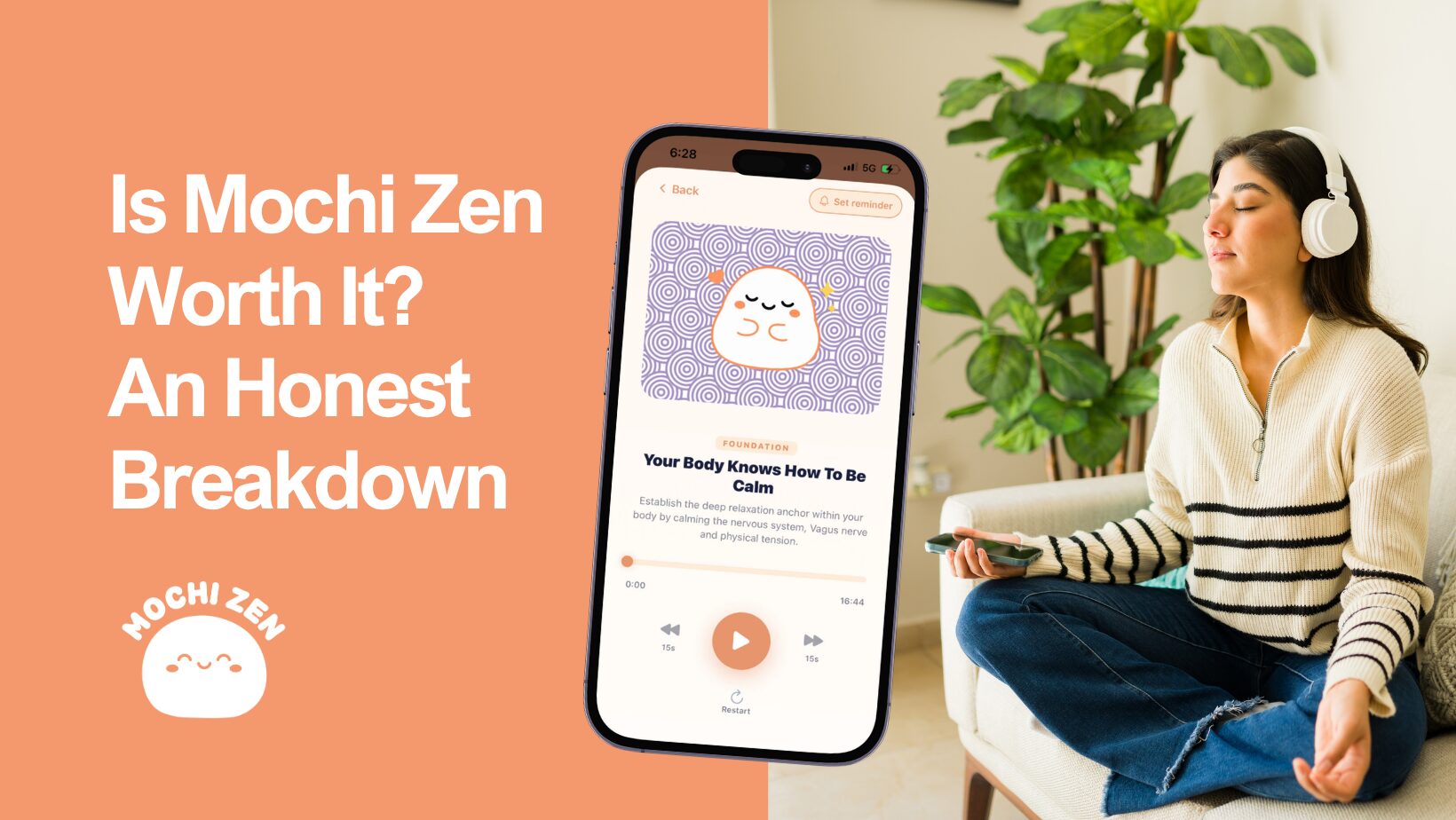
You're not going to get a sales pitch here. You're going to get an honest answer.
I'm Paola Mendez, certified RTT (Rapid Transformational Therapy) hypnotherapist, trained under the Marisa Peer method, and the person who built Mochi Zen. Which means I'm probably the most biased person you could ask about whether this app is worth it. I'm also the person who knows most honestly what it does and doesn't do, who it's genuinely right for, and where the free alternatives might actually serve you better.
So here's the breakdown I'd give a friend who asked.
Not sure yet? You don't have to decide on $15 a month today. Try Mochi Zen free for 7 days, no credit card required to start.
Try Mochi Zen Free for 7 Days →What's in this article
What Mochi Zen Actually Is
Mochi Zen combines RTT-based hypnotherapy audio sessions with AI-powered nutrition tracking, in one place. It launched with a focus on weight loss, and that's still a core program. But the app has expanded: there's now an anxiety program, an insomnia program, and more programs in development. The through-line across all of them is the same: RTT works at the subconscious level to address the root of the pattern, not just the surface behavior.
Here's what you get inside the app:
- RTT hypnotherapy audio sessions: created by me, based on the Rapid Transformational Therapy method developed by Marisa Peer. Available across three programs: Weight Loss, Anxiety, and Insomnia, with more on the way. Each session works with your subconscious to address the root belief or emotional pattern driving the issue, not willpower, not symptom management. The why underneath the behavior.
- AI meal scanner: photograph your food and get an instant nutritional breakdown.
- Typed-sentence logging: type what you ate in ordinary words. Mochi Zen calculates portions, calories, and macros for each food automatically so you can log without searching long lists.
- Macros calculator and USDA food logging: full nutrition tracking with a comprehensive food database for what you eat regularly.
- Exercise and water tracking: add activities and water right alongside your meals. See your active minutes, burned calories, and progress toward your 64-ounce water goal on your daily screen.
- Weight tracker: simple, visual, no judgment.
- Daily journal: to note what you're feeling, what you're eating, what patterns you're noticing.
The combination is intentional. Whether it's food, anxiety, or sleep, most people aren't struggling because they lack information. They're struggling because something subconscious keeps overriding what they know. The hypnotherapy addresses that layer. The tracking tools keep the conscious choices aligned with the shift. Both sides need to work together for lasting change.
The Research Behind the Programs
If you're wondering whether RTT hypnotherapy is backed by peer-reviewed evidence, the short answer is yes, across all three areas the app covers:
- Weight loss: A landmark 1995 meta-analysis in the Journal of Consulting and Clinical Psychology (Kirsch, Montgomery & Sapirstein) found that patients who added hypnotherapy to their weight loss treatment lost more than twice as much weight as those who didn't, and continued losing at a two-year follow-up. A 2025 clinical trial at Hadassah Medical Center found hypnosis-simulated gastric sleeve surgery produced 10% average body weight loss, with 86% of participants still losing at three months. Kirsch et al., PubMed →
- Anxiety: Multiple meta-analyses confirm significant anxiety reduction with hypnotherapy. A 2019 meta-analysis in the International Journal of Clinical and Experimental Hypnosis found meaningful positive effects across anxiety presentations. A 2010 review in Expert Review of Neurotherapeutics reached the same conclusion. 2019 meta-analysis →
- Insomnia: A systematic review in the Journal of Clinical Sleep Medicine (2018) analyzed 24 studies and found hypnotic suggestion increased deep sleep by 81% in highly suggestible individuals, with no adverse effects across 13 clinical trials. A separate 2015 meta-analysis found hypnotherapy significantly reduced sleep onset time. JCSM review →
Who Mochi Zen Is Genuinely For (And Who It's Not)
It's for you if:
- You've tried calorie-counting apps and they worked temporarily but didn't stick.
- You eat well most of the time and then something triggers a binge or a pattern you can't explain.
- You know what you "should" be eating but find yourself doing something different anyway.
- You've tried Noom, MyFitnessPal, or Weight Watchers and the tools were fine but didn't address why you were eating.
- You deal with anxiety that feels like it runs on autopilot, and you want to address it at the root rather than just manage symptoms.
- You struggle with sleep and have tried the usual fixes (sleep hygiene, melatonin, white noise) without lasting results.
- You're curious about hypnotherapy but $500 for a private session feels like a big commitment before you know if it works for you.
- You want a low-risk way to experience RTT hypnotherapy before booking a full private session.
It's probably not for you if:
- You're looking for a meal plan or structured diet program. Mochi Zen tracks and supports, but doesn't prescribe exactly what to eat.
- You're dealing with a diagnosed eating disorder. Please work with a specialized clinical therapist first. Mochi Zen is not a replacement for clinical care.
- You want a calorie-tracking app and nothing else. MyFitnessPal is free and excellent for pure calorie logging.
Mochi Zen is available on iOS, Android, and web. The 7-day free trial gives you full access to everything, hypnotherapy sessions included.
Start Your Free 7-Day Trial →How It Compares: Mochi Zen vs. Free Alternatives
| Feature | Mochi Zen | MyFitnessPal (Free) | Noom | Calm / Headspace |
|---|---|---|---|---|
| RTT hypnotherapy sessions | ✓ | ✗ | ✗ | ✗ |
| Addresses root cause of eating patterns | ✓ | ✗ | Partial | ✗ |
| AI meal scanner | ✓ | ✗ (paid only) | ✓ | ✗ |
| Nutrition tracking + USDA food database | ✓ | ✓ | Partial | ✗ |
| Typed-sentence food logging (AI) | ✓ | ✗ (voice log, paid only) | ✓ | ✗ |
| Exercise tracking | ✓ | ✓ | ✓ | ✗ |
| Water tracking | ✓ | ✓ | ✓ | ✗ |
| Weight tracker | ✓ | ✓ | ✓ | ✗ |
| Daily journal | ✓ | ✗ | Partial | Partial |
| Built by a certified RTT practitioner | ✓ | ✗ | ✗ | ✗ |
| Monthly price | $15/mo or $120/yr | Free (basic) | ~$60/mo | ~$15/mo |
| Free trial | 7 days, full access | Always free | 14-day trial | 7 days |
The honest summary: MyFitnessPal is the best free calorie tracker that exists. If you want to count calories and macros and nothing else, use MyFitnessPal; it's excellent and free. Noom is significantly more expensive than Mochi Zen and doesn't include hypnotherapy; it uses a color-coding system and daily lessons, which works for some people and doesn't for others. Calm and Headspace offer general meditation and relaxation; they're not designed for weight or eating patterns specifically.
What none of them offer is what Mochi Zen was built to do: address why you eat the way you do at the subconscious level, while also giving you the tools to track what you're actually eating. That combination doesn't exist anywhere else.
The Real Cost Question
$15 a month feels like a real number when you're looking at it on a pricing page. Here's the context that helps it land differently.
What $15/month compares to
But the more honest cost question isn't about the $15. It's about the cost of doing nothing.
If the pattern you're in right now (the emotional eating, the cycle of restricting and binging, the exhaustion of fighting cravings) has been running for one year, or five years, or ten years, what has that actually cost? In energy, in mental space, in failed attempts, in the confidence that quietly erodes every time a diet ends the same way it started?
I'm not saying that to make you feel bad. I'm saying it because the question of whether $15 a month is "worth it" has to be asked against the right baseline. And the baseline isn't "free apps"; it's the cost of the problem continuing.
The 7-day free trial removes the financial risk entirely: no credit card required to start. You try it at zero cost, and if it's not for you, simply don't upgrade. Nothing owed.
What Mochi Zen Doesn't Do
Honesty matters here, so I'll name the limitations clearly.
Mochi Zen is not a meal plan. If you want to be told exactly what to eat each day, this isn't that. The RTT sessions shift why you eat. The tracking tools show you what you eat. The decisions in between are still yours.
Mochi Zen is not a replacement for a private RTT session if you need one. The audio sessions in the app are powerful; they're built on the same RTT methodology I use with private clients. But a private 90-minute session is a personalized, one-on-one experience where we go back to your specific memories and reframe your specific beliefs. If you've been dealing with deep trauma, longstanding disordered eating, or complex emotional patterns, a private session will go deeper than an app can. Mochi Zen is a meaningful starting point, and for many people, exactly what they need. For others, it's the bridge to deciding whether to book a private session.
Results vary. RTT works for the vast majority of people who engage with it consistently. But "consistently" means listening to the sessions, using the journal, and being genuinely willing to examine what's driving your relationship with food. It's not passive. If you download it and open it twice, it won't do much, the same way a gym membership doesn't make you fitter if you drive past it.
My Honest Verdict
If you're a chronic dieter who's gotten good at the behavior but can't understand why it keeps reverting, Mochi Zen is probably the thing you haven't tried yet. Not because it's magic. Because it goes to the part of your brain that the calorie trackers and the diet programs never reached.
And if weight loss isn't your primary concern right now (if it's anxiety that keeps you up, or sleep that won't come no matter what you try), the same RTT approach applies. The anxiety and insomnia programs inside Mochi Zen work on the same principle: find the subconscious pattern driving the problem, update it, and watch what changes in daily life.
The 7-day free trial means you have nothing to lose by trying. Everything in the app, including the RTT sessions, is available from Day 1. That's enough time to feel whether it lands for you.
Frequently Asked Questions
Is Mochi Zen really free to try?
Yes. The 7-day free trial gives you full access to everything in the app, including the RTT hypnotherapy sessions, AI meal scanner, typed-sentence food logging, exercise and water tracking, weight tracker, and daily journal. No credit card required to start. Just download, try it free for 7 days, and upgrade only if you want to continue.
How is Mochi Zen different from MyFitnessPal?
MyFitnessPal is a calorie and macro tracker, one of the best available. Mochi Zen includes nutrition tracking, but it also addresses why you eat the way you do through RTT-based hypnotherapy audio sessions. If you've used MFP and the tracking didn't lead to lasting change, it's likely because the root cause (the emotional and subconscious patterns driving your eating) wasn't addressed. That's what Mochi Zen does differently.
How is Mochi Zen different from Noom?
Noom uses a food color-coding system and daily educational content. It's significantly more expensive (around $60/month vs. $15/month for Mochi Zen). Neither approach is wrong, but Noom works at the conscious, behavioral level. Mochi Zen combines RTT hypnotherapy, which works with the subconscious, with practical nutrition tracking. If you've tried Noom and the pattern returned, the root cause wasn't addressed.
Do I need to believe in hypnotherapy for it to work?
No. You need to be open to listening with your eyes closed and giving it a fair try. The RTT sessions in Mochi Zen are audio: you listen during a relaxed state. Many of the most impactful results have come from people who were skeptical going in. Curiosity is enough. Belief is not required.
What if I want a more personalized experience?
Mochi Zen is a meaningful starting point for many people. If you want a one-on-one, 90-minute RTT session tailored specifically to your memories, patterns, and beliefs, I offer private sessions through my practice, Pao Hypnosis. Many Mochi Zen users start with the app and then book a private session when they're ready to go deeper.
Is Mochi Zen available on iPhone and Android?
Yes. Mochi Zen is available on the Apple App Store, Google Play, and as a web app at app.mochi-zen.com, so you can use it on any device.
Is Mochi Zen only for weight loss?
No. Mochi Zen launched with a weight loss focus, but the app now includes an anxiety program and an insomnia program, with more in development. All three programs are built on the same RTT methodology: hypnotherapy audio sessions designed to address the subconscious root of the pattern, whether that's emotional eating, anxious thought loops, or difficulty sleeping. The nutrition tracking tools in the app are weight-loss specific, but the RTT sessions span all three areas.
Who created Mochi Zen?
Mochi Zen was founded by Paola Mendez, certified RTT hypnotherapist, trained under the Marisa Peer method, and a former software developer with over a decade in tech. The app combines her clinical expertise in RTT with her technical background to build the tool she wishes had existed when she was working with her own relationship with food and the subconscious. The RTT sessions inside the app are created by Paola and built on the same methodology she uses with private clients.
Disclaimer: The research cited in this article is provided for informational purposes. Results vary. Hypnotherapy is not a substitute for medical treatment.