If you’ve tried every diet, every app, every program, and you keep finding yourself back where you started, there’s something no calorie counter will ever fix: the reason you eat the way you do.
That’s exactly where hypnotherapy for weight loss works differently.
This isn’t about more willpower. It isn’t about tracking more diligently or finding a cleaner eating plan. RTT-based hypnotherapy works at the subconscious level, where your food habits, emotional eating patterns, and deepest beliefs about your body actually live. And the research is clear: in a landmark study published in the Journal of Consulting and Clinical Psychology, patients who combined hypnotherapy with their weight loss efforts lost more than twice as much weight as those who didn’t, and the results held at a two-year follow-up (Kirsch, Montgomery & Sapirstein, 1995).
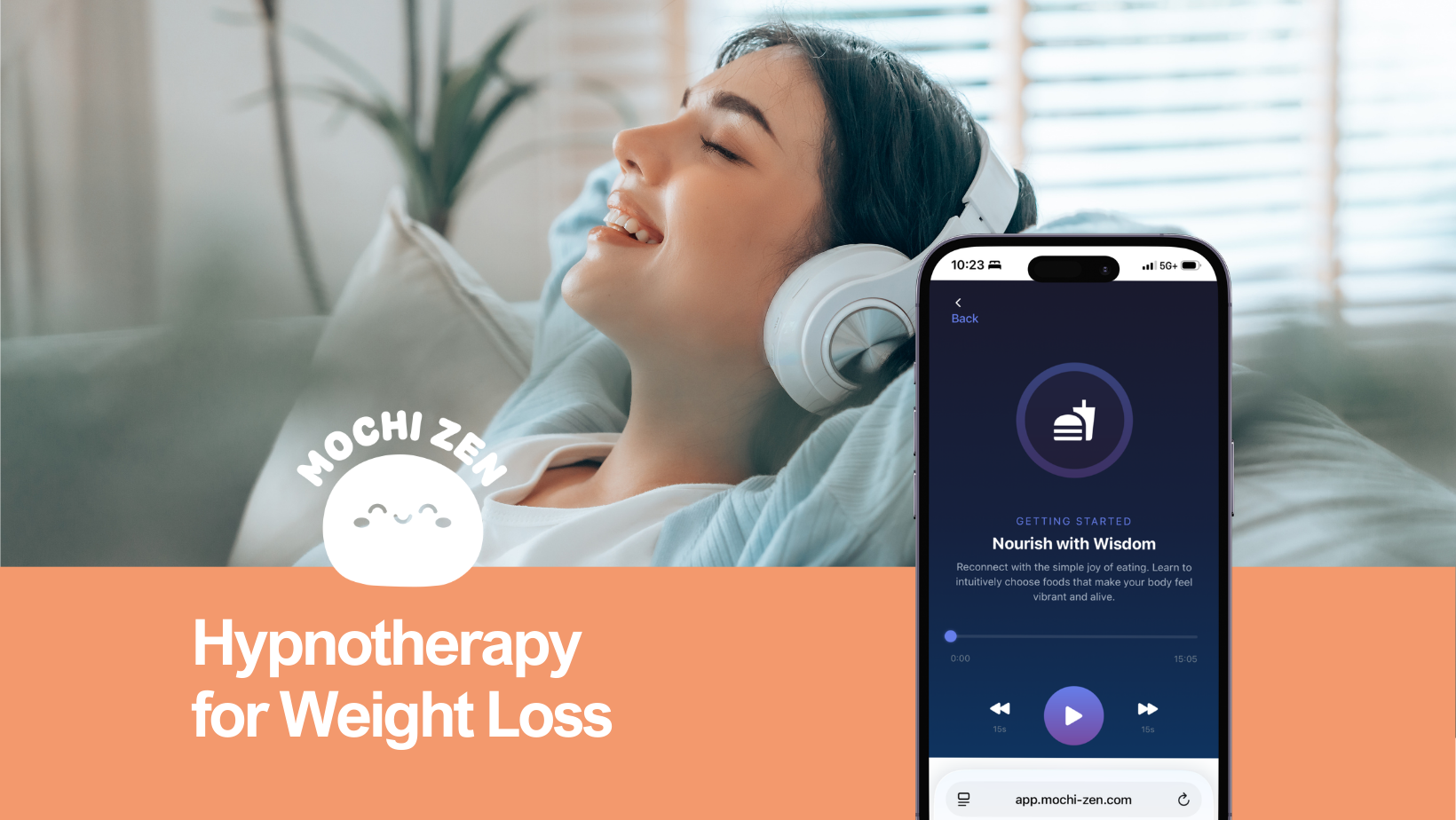
Ready to stop fighting cravings and address what’s driving them? Mochi Zen combines RTT-based hypnotherapy sessions with AI-powered nutrition tracking, so you can heal the why and track the what, in one app.
Why Diets Keep Failing (And It’s Not a Willpower Problem)
Most weight loss advice treats the body like a math equation: eat less, move more. The problem is that eating is not primarily a logical behavior.
For most people, especially chronic dieters and emotional eaters, what, when, and how much they eat is driven by deeply embedded subconscious patterns. These patterns form early. A child who was comforted with food learns to associate eating with safety and love. A teenager who was criticized for their body may carry a hidden belief that they don’t deserve to feel well in it. An adult who stress-eats at 10pm every night isn’t failing at discipline; they’re running a subconscious program that says food equals relief.
No app can overwrite a subconscious program by tracking macros. The subconscious mind governs an estimated 95% of our behavior, including automatic eating habits, emotional responses to food, and the beliefs we hold about our own bodies. That’s the level hypnotherapy works at.
What Is Hypnotherapy for Weight Loss?
Hypnotherapy for weight loss is a therapeutic approach that uses a deeply relaxed, focused state of mind (a hypnotic state) to access and reprogram the subconscious beliefs and patterns driving unwanted eating behaviors.
In this state, the critical, analytical part of the mind quiets down. That opens a direct channel to the deeper layer where beliefs and automatic behaviors are stored: the part that resists conscious willpower. A skilled hypnotherapist guides the client to identify where their patterns came from, understand why they formed, and replace them with beliefs that actually serve who they are today.
Common patterns that hypnotherapy for weight loss addresses include:
- “I can’t stop eating once I start”
- “I need food to feel calm or happy”
- “Losing weight is impossible for me”
- “I always sabotage myself when things are going well”
- “I eat when I’m bored, stressed, lonely, or overwhelmed”
This is not stage hypnosis. You are not “under” anything. You remain fully aware and in control throughout the session; it simply feels like a profoundly relaxed, focused state, similar to the feeling just before sleep.
What Makes RTT Different from Regular Hypnotherapy
RTT (Rapid Transformational Therapy) is a methodology developed by world-renowned therapist Marisa Peer. It combines the most effective principles of hypnotherapy, psychotherapy, neuro-linguistic programming (NLP), and cognitive behavioral therapy into a focused, results-driven approach designed to produce real change, quickly.
What makes RTT especially powerful for weight loss is its emphasis on identifying the root cause of a behavior, not just managing the symptom. An RTT session doesn’t just suggest new habits. The work goes back to the origin of the belief, often to formative childhood experiences, to understand why the pattern was created in the first place. Once the root is understood and addressed, the behavior often shifts naturally and permanently.
I’ve seen this firsthand. One of my clients came to me with chronic pain, loss of mobility, and a body they felt completely disconnected from. Through our RTT work together, they fell in love with movement, lost 130 pounds from their heaviest weight, healed their back pain, came out of a depression, and rebuilt their relationship. A complete life rebuilt, from the inside out. The transformations are so significant that even I am moved when I witness them.
My name is Paola Mendez. I’m a certified RTT practitioner trained in Marisa Peer’s methodology. Before becoming a hypnotherapist, I spent over a decade as a software developer, which means I understand both the technology and the deeply human side of behavior change. That dual perspective is exactly what I built into Mochi Zen.
What the Research Says About Hypnotherapy and Weight Loss
The science supporting hypnotherapy for weight loss is more robust than most people realize.
In a landmark meta-analysis published in the Journal of Consulting and Clinical Psychology, researcher Irving Kirsch and colleagues analyzed 18 studies comparing weight loss outcomes with and without hypnotherapy. Their conclusion: patients in the hypnotherapy groups lost more than twice the weight of those in control groups, and critically, continued to lose weight during the follow-up period, while the control groups did not (Kirsch, Montgomery & Sapirstein, 1995).
The National Center for Complementary and Integrative Health (NCCIH) also recognizes hypnotherapy as a legitimate mind-body practice, noting its use in pain management, behavioral change, and anxiety reduction, all of which are directly relevant to emotional eating and weight management.
The mechanism makes sense: if 95% of behavior is driven by the subconscious mind, then approaches that work directly with the subconscious will naturally produce deeper, more lasting change than those that only address conscious behavior.
What an RTT-Based Hypnotherapy Session for Weight Loss Looks Like
An RTT session is nothing like what you might imagine. It’s a deep, guided conversation (part therapy, part hypnosis) that typically lasts about 90 minutes.
Here’s what generally happens:
- You enter a relaxed state. Your practitioner guides you into a calm, focused state of mind where the subconscious is more accessible.
- You explore the why. Together, you’ll revisit experiences and beliefs that shaped your current relationship with food, often going back to childhood or teenage years.
- You upgrade and release. You’ll understand the meaning you attached to those moments and actively replace limiting beliefs with new, empowering ones.
- You receive a personalized recording. After the session, you get a custom audio to listen to daily for 21 days, reinforcing the new beliefs and rewiring the neural pathways associated with old behaviors.
Many clients notice a shift in cravings, emotional eating, and how they feel about food within the first few days. This is the RTT effect: when the root belief changes, the behavior follows.
Who Is Hypnotherapy for Weight Loss Right For?
RTT-based hypnotherapy tends to work best for people who:
- Have tried multiple diets or programs without lasting results
- Recognize that their eating is tied to emotions: stress, boredom, comfort, reward, or habit
- Want to understand why they eat the way they do, not just change what they eat
- Are open to the idea that the mind plays a powerful role in physical change
- Feel stuck in a cycle they haven’t been able to break through willpower alone
This is especially relevant for women in their 30s, 40s, and 50s who have been chronic dieters: who know all the rules, follow them for a while, and then find themselves back at the beginning. The issue is never a lack of knowledge. It’s a subconscious program running underneath the conscious effort, and that’s exactly what RTT addresses.
Hypnotherapy for Weight Loss vs. Other Apps and Programs
You’ve probably already tried some version of the alternatives. Here’s how RTT-based hypnotherapy compares:
vs. Noom: Noom uses color-coded food categories and psychological coaching. It’s a step beyond calorie counting, but it still works at the level of conscious behavior change. It doesn’t address the subconscious driver underneath the habit, which is why so many Noom users find themselves reverting once the novelty wears off.
vs. MyFitnessPal: MyFitnessPal tracks what you eat with precision. But tracking requires discipline and awareness every single day, and neither of those fixes the emotional or subconscious pattern underneath the behavior. You can track your way to a perfect food log and still binge on Saturday night.
vs. Calm or Headspace: These apps offer general mindfulness and meditation, which has real value. But they weren’t built for weight loss, and general relaxation is categorically different from targeted RTT work on specific food-related beliefs and emotional patterns.
Mochi Zen is the only app that brings RTT-based hypnotherapy specifically for weight loss together with full AI-powered nutrition tracking. You’re not choosing between fixing the why and tracking the what; you get both, in one place.
Want to experience what RTT-based hypnotherapy feels like before committing? Mochi Zen’s 7-day free trial includes the full hypnotherapy audio recording for the first week, AI meal scanner, macro tracker, and daily journal.
How to Start RTT-Based Hypnotherapy for Weight Loss
There are two ways to experience RTT for weight loss, depending on how deep you want to go:
1:1 Private RTT Sessions
For a fully personalized, deep-dive experience, a private session with a certified RTT practitioner goes furthest. Sessions typically run 90 minutes and include a custom personalized audio recording you use for 21 days afterward. I offer private RTT sessions for weight loss, emotional eating, and overall transformation through my practice, Pao Hypnosis, available in person in Miami and remotely worldwide.
The Mochi Zen App
Mochi Zen makes RTT-based hypnotherapy accessible every day, not just in scheduled sessions. The app includes a library of RTT-based audio sessions designed specifically for weight loss and emotional eating, paired with an AI photo meal scanner, typed-sentence logging, a USDA food search, exercise and water tracking, a macros calculator, a weight tracker, and a daily journal. Start with a free 7-day trial at mochi-zen.com.
Frequently Asked Questions About Hypnotherapy for Weight Loss
Does hypnotherapy for weight loss actually work?
Yes, and the research supports it. A landmark meta-analysis by Kirsch, Montgomery, and Sapirstein (1995) found that patients who added hypnotherapy to their weight loss efforts lost more than twice the weight of those who didn’t, with results that held at a two-year follow-up. Hypnotherapy works by addressing the subconscious patterns (emotional eating, self-sabotage, food-as-comfort habits) that most conventional programs never touch.
How many hypnotherapy sessions do you need to lose weight?
With RTT, many clients notice meaningful shifts after just one session, because the work goes directly to the root cause of the behavior rather than managing symptoms. That said, every person is different. A single private RTT session is followed by a 21-day personalized audio protocol. The Mochi Zen app provides ongoing RTT-based audio sessions you can listen to daily, which supports continued reinforcement over time.
What is RTT and how is it different from regular hypnotherapy?
RTT (Rapid Transformational Therapy) is a methodology developed by world-renowned therapist Marisa Peer. It combines hypnotherapy with psychotherapy, NLP, and CBT to identify and resolve the root cause of a behavior, not just manage it. Where standard hypnotherapy might use suggestion alone, RTT takes you back to the origin of the belief driving the behavior and actively rewrites it. The result is faster, deeper, and more lasting change.
Can hypnotherapy help with emotional eating?
This is one of the areas where hypnotherapy, and RTT specifically, is most effective. Emotional eating is almost always rooted in a subconscious association: food = comfort, safety, reward, or relief. These associations were formed at a specific moment in the past. RTT helps you identify that moment, understand why you made that association, and replace it with a healthier relationship with both food and your emotions.
Is hypnotherapy for weight loss safe?
Yes. Hypnotherapy is a non-invasive, drug-free therapeutic approach. You are conscious and in control throughout the session; the hypnotic state is simply a deeply relaxed, focused state of awareness. It is recognized as a legitimate mind-body practice by the National Center for Complementary and Integrative Health. As with any therapeutic approach, it’s important to work with a trained, certified practitioner.
How long does it take to see results from weight loss hypnotherapy?
Many clients notice a shift in their relationship with food (reduced cravings, less emotional eating, a different feeling when they approach meals) within the first few days of beginning RTT work. Physical weight loss follows at an individual pace, influenced by consistency with the audio protocol and any nutrition tracking. Most clients who commit to 21 days of daily listening report significant behavioral change by the end of that period.
What is the best hypnotherapy app for weight loss?
Mochi Zen is the only app that combines RTT-based hypnotherapy sessions, built on Marisa Peer’s Rapid Transformational Therapy methodology, with a full AI nutrition tracking suite. Most wellness apps offer either mindfulness or calorie tracking. Mochi Zen offers both, built specifically around the root-cause approach to weight loss. Start with a 7-day free trial at mochi-zen.com.
Can I do hypnotherapy for weight loss at home?
Absolutely. RTT-based hypnotherapy sessions are available remotely: private 1:1 sessions can be done via video from anywhere in the world. The Mochi Zen app takes this further by delivering RTT-based audio sessions you can listen to at home, at your own pace, as part of your daily routine. Most clients listen at night before sleep or in the morning, two times when the subconscious mind is most receptive.
The most common thing I hear from people after their first RTT session: “I finally understand why I was doing that.” That understanding is where real, lasting change begins. You’ve spent long enough fighting your own habits. Mochi Zen was built to help you heal them instead.
About the Author: Paola Mendez
Paola Mendez is a certified Rapid Transformational Therapy (RTT) practitioner, trained in the methodology developed by world-renowned therapist Marisa Peer. A former software developer with over a decade in tech, Paola founded Mochi Zen to make RTT-based hypnotherapy for weight loss accessible to anyone, anywhere. She also sees private clients for 1:1 RTT sessions through her practice, Pao Hypnosis, in Miami and remotely worldwide.